You've Been Reading an Incomplete Bible — And Nobody Told You
The Ethiopian tradition preserved 88 books for over 1,600 years. The version you grew up with has 66. What happened to the other 22 — and where can you find a complete edition that actually delivers what it promises?


Something has been bothering you about your Bible. Maybe it started with a YouTube video about the Book of Enoch. Maybe it was that conversation after church where someone mentioned the "Ethiopian Bible." Maybe it was the moment in February 2026 when Mel Gibson made headlines by saying the version most Western Christians read is not the complete story.
However you arrived here, you are now asking a question that millions of American Christians are quietly asking: Is the Bible I've been reading my whole life actually complete? The answer — according to 1,600 years of Ethiopian Christian tradition — is no.

The Ethiopian Orthodox Tewahedo Church has preserved a biblical canon with 88 books. The Protestant Bible you likely grew up with has 66. The Catholic Bible has 73. The Ethiopian tradition includes texts that were part of early Christian communities for centuries before they were removed from Western canons during ecclesiastical decisions made in the 4th and 5th centuries. Among the books the Ethiopian tradition preserved: the Book of Enoch — a text describing the fall of the Watchers, the origins of the Nephilim, and prophecies that predate the flood. The Book of Jubilees, which retells Genesis with details your Bible summarizes or skips entirely. The Meqabyan — three books that exist in no other Christian tradition on earth.
⚠ What to Watch For Before You Buy Any Ethiopian Bible
The Ethiopian Bible market is one of the most misleading categories on Amazon right now. Here is what the research shows — so you know exactly what red flags to look for before spending money.
Red Flag #1: "Complete 88 Books" without a visible table of contents. The Ethiopian Orthodox Bible Project — the most authoritative English-language source on this topic — has publicly stated that every "complete" English Ethiopian Bible currently listed on Amazon is incorrect. Not some of them. All of them. If a listing claims "88 books" but won't show you the table of contents before purchase, that is a warning sign.
Red Flag #2: The typo problem is documented and severe. One verified Walmart buyer described what they found after opening a bestselling Ethiopian Bible edition: "In Jubilees, the same chapter text was repeated 3 times... 1 Enoch has Semjaza spelled 4 different ways." This is not an isolated complaint. The Ethiopian Orthodox Bible Project called competing editions "riddled with typos and appear hastily assembled."
Red Flag #3: The print size problem is real. A Goodreads reviewer described a popular Ethiopian Bible as having "telephone book size and girth" with "small print (despite so-called large print)." If a listing doesn't state the font size or show a sample page spread, you cannot know what you're about to receive.
Red Flag #4: Digital bonuses with no proof of delivery. One verified buyer found that the promised digital content led to a QR code that directed them to download a messenger app — not the content they paid for. Know what to look for. Then look for it.
They are all incorrect. In addition, most of them are in very tiny print, riddled with typos and appear hastily assembled.— Ethiopian Orthodox Bible Project, public assessment of English Ethiopian Bible editions
You have probably started researching how to find these texts. And if you have, you have almost certainly run into these problems. Browse the listings. You'll see claims like "Complete 88 Books" for $27. You'll see five-star ratings next to one-star warnings. You'll see promises of digital bonuses and video content — with no way to verify any of it works before you hand over your credit card. Before you buy anything, read the next section carefully.
Here Is What Nobody in This Market Has Been Willing to Tell You

The books that were removed from the Western Bible were not lost. They were not discovered in a cave last century. They were not suppressed in secret. They were preserved — openly, continuously, for over 1,600 years — by the Ethiopian Orthodox Tewahedo Church. Monks in the highlands of Ethiopia kept these texts. Priests read from them at liturgy. Children in the Ethiopian tradition grew up with them.
The Garima Gospels, housed in a monastery in northern Ethiopia, are among the oldest surviving bound books in the world — dating to around 390–570 AD. The Ethiopian church was reading 88 books before the Western canon was officially closed. This is not a conspiracy. It is church history.
— Ethiopian Heritage Fund / Garima Gospels historical recordWhat it means for you, right now, is this: the 22 books that are not in your Bible are not mysterious or lost. They exist in a complete, preserved tradition. The question is not whether these books are real. The question is whether you can find an edition that actually delivers them — all of them, in readable print, proofread, without sending you to a messenger app when you scan a QR code.
That is the problem this guide was written to help you solve. Before you spend a single dollar, see what a verified complete edition actually looks like →
What to Look For in a Complete Ethiopian Bible — And How to Verify It

The Ethiopian Bible — Complete 88 Books, available at NovAFindshub.com, was built specifically to address the documented failures in this category. Before you purchase any edition — including this one — here is exactly how to verify it meets the standard.
The most authoritative single-verse proof in this entire category comes from your own Bible: Jude 1:14-15. Open any Bible you already own. Read it. Jude — a New Testament author — directly quotes the Book of Enoch and calls Enoch a prophet. If the text you're considering includes the Book of Enoch, you are not reading heresy. You are reading what the New Testament itself cited as authoritative. That is your permission, from Scripture, before you spend a dollar.
How to Verify Any Ethiopian Bible Before You Buy
Find the Full Table of Contents
A legitimate complete edition will show every book by name, in order, before you purchase. If the listing doesn't publish a visible TOC, assume the "complete" claim is unverified. Count the books yourself.
Find a Sample Page and Check Font Size
Readable editions state their font size (12pt or larger) and show actual interior pages — not just the cover. If all you can see is the cover, you cannot verify the readability claim before spending money.
Confirm With Jude 1:14-15
Open any Bible you own. Read Jude 1:14-15. Jude directly quotes the Book of Enoch and calls Enoch a prophet. That is your permission, from Scripture itself, before you purchase anything.
What Readers Found When They Finally Looked

You are not the first person to go searching for this. The curiosity that brought you here has driven millions of American readers — 56% of Americans, according to the American Bible Society's 2025 State of the Bible report, say they are curious about the Bible. Among those who are interested but not yet engaged, that figure reaches 82%.
Here is what some of them discovered when they finally found a complete edition: readers who picked up the Book of Enoch for the first time described being "amazed" and finding it "opened my eyes in ways I didn't expect." One Goodreads reader wrote that Enoch "reads like an adventure of epic proportions." These are not fringe readers. They are people exactly like you — Christians who suspected something was missing, went looking, and found that the Ethiopian tradition had kept it safe.
I am on a journey of truth for my soul that is only judged by God and not a church.— Orthodox Christian Laity reader (ocl.org, verified)
The question before you is not whether these books exist. They do. The question is whether the edition you're about to consider actually contains them — all of them, intact, readable, and verified. See the full table of contents before you buy →
"Is It a Sin to Read Books That Aren't in My Bible?"
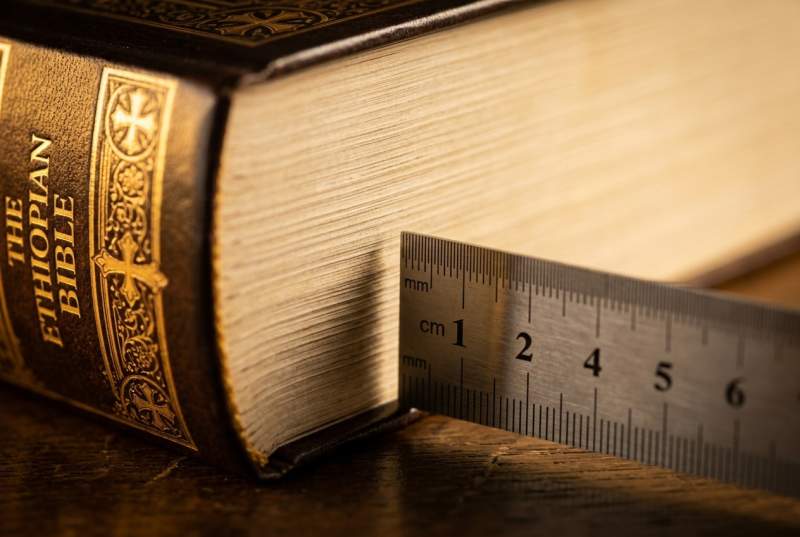
This is the question that stops most people before they even start looking. Here is the answer — not from a seller, not from a marketer, but from Scripture itself. Open your Bible to Jude 1:14-15. Read it. The Apostle Jude quotes the Book of Enoch directly, calls Enoch a prophet, and cites his prophecy as authoritative truth. Jude is in your Bible. The text he quoted is in the Ethiopian Bible.
If reading the Book of Enoch is heresy, then Jude — a New Testament author — endorsed heresy. He didn't. The early church knew these texts. The Ethiopian tradition kept them. Now you can read them. The permission isn't coming from a marketer or a seller. It's already in the book you grew up with.
The $59 edition includes the full Book of Enoch, in context, proofread, alongside the 21 other books the Ethiopian tradition preserved. Free shipping. 30-day verification window — if it's not what it claims, you don't keep it.