There Is a Verse in Your Bible That Quotes a Book Your Bible Doesn't Have
Most people read right past it. The ones who stop and look deeper discover something that has been hiding in plain sight for two thousand years.


There is a verse in your Bible that quotes a book your Bible doesn't have. Most people read it every week without noticing. It appears near the end of the New Testament, tucked into a short letter most Christians could not name without checking the table of contents. And for two thousand years, that one small verse has been pointing toward something most Western readers have never seen.
The letter is called Jude. It is one page long. On that page, the author — widely identified in Christian tradition as Jude, the brother of James — quotes a prophecy by name, attributes it to "Enoch, the seventh from Adam," and presents it as authoritative truth. "Behold, the Lord comes with ten thousands of His saints." The words are presented without qualification, without apology, as prophecy.
The Book of Enoch is not in your Bible. But Jude is. And Jude quotes Enoch directly.
The Book That Was Already There — Before You Knew to Look
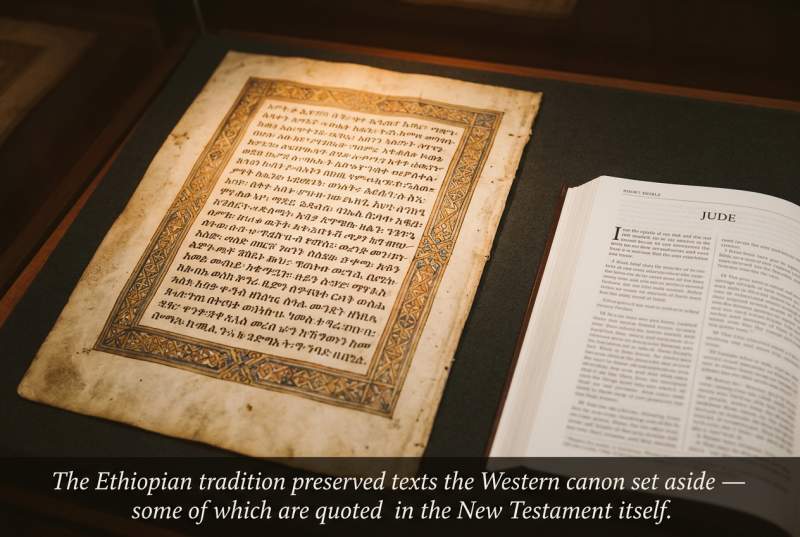
For most American Christians, the Bible they hold contains sixty-six books. They were taught this was the complete Scripture. They were not taught that another branch of the Christian world — one of the oldest on earth — preserved a different count entirely. And they were almost certainly never told that a passage from one of those additional books had been sitting in their own Bible the entire time.
The Ethiopian Orthodox Tewahedo Church is among the oldest continuously practicing Christian institutions in the world. Christian communities existed in the region of modern Ethiopia by the first century — within decades of the events described in the Gospels. The Ethiopian eunuch in the Book of Acts, returning from Jerusalem with Scripture in hand, is one of the earliest conversion accounts in the New Testament. The Church he represents never disappeared. It continued through empires, invasions, and centuries of isolation, and it preserved something that other Christian traditions eventually set aside.
That something is a broader collection of sacred texts — texts that include the Book of Enoch, the Book of Jubilees, the Books of Meqabyan, and others — which the Ethiopian tradition considers canonical scripture, not merely interesting historical documents. The count of books in the Ethiopian canon is debated among scholars, but all versions of it significantly exceed the sixty-six books most American Christians know.
The question that curiosity is circling, increasingly, is this one: Is what I have actually complete?
What Scholars Have Noticed — and Most Readers Have Not

The observation about Jude and Enoch is not controversial in academic circles. Biblical scholars have noted the connection for centuries. What is striking is how rarely it is discussed outside of those circles — and how few ordinary readers ever encounter it.
The passage in Jude reads: "Enoch, the seventh from Adam, prophesied about these men, saying, 'Behold, the Lord comes with ten thousands of His saints, to execute judgment on all, to convict all who are ungodly...'" (Jude 1:14-15, NKJV). Those words do not appear in Genesis, where Enoch is briefly mentioned. They do not appear anywhere in the sixty-six-book canon. They appear, almost verbatim, in 1 Enoch 1:9 — a text preserved in the Ethiopian canon and held there as scripture for two millennia.
Mainstream Reformed scholarship has acknowledged this. Scholars who study the relationship between the New Testament and Second Temple Jewish literature treat the Enoch connection as foundational context for understanding early Christian thought. The book that Jude quotes — the book that Western Christianity eventually excluded — shaped the theological imagination of the New Testament world.
When we looked at what is available to English-speaking readers who want to explore this tradition, the picture was considerably less encouraging than the scholarship would suggest. We found category-wide problems that no seller has addressed. The Ethiopian Orthodox Bible Project, the most authoritative English-language voice on this subject, has made a pointed assessment: that every "complete" English Ethiopian Bible currently available is incorrect, most are printed in very tiny type, and they appear hastily assembled.
One buyer who purchased what was described as a complete edition on a major retail platform left a detailed review in January 2026: there were a significant number of typos, one chapter text was repeated three times, and a single angel's name was spelled four different ways across the same volume. This is not an isolated complaint. It is a pattern.
"They are all incorrect. In addition, most of them are in very tiny print, riddled with typos and appear hastily assembled."— Ethiopian Orthodox Bible Project
The pattern of editorial failure is not an accident. It is what happens when a category is shaped by sellers who prioritize the claim of completeness over the reality of it.
An Ancient Tradition — and the Modern Effort to Bring It Home
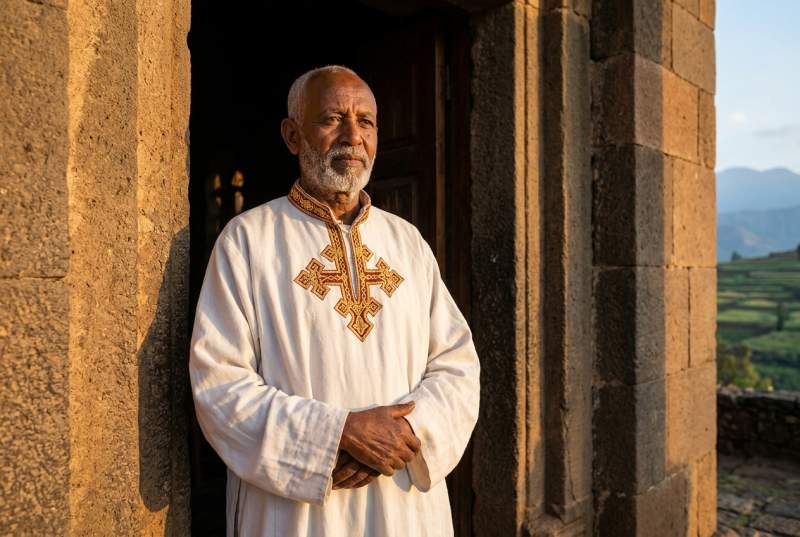
The Ethiopian Christian tradition's preservation of a broader scriptural canon is not a matter of fringe scholarship. The Garima Gospels, housed at Abba Garima Monastery in northern Ethiopia, are among the oldest surviving Gospel manuscripts anywhere in the world. The country's Christian heritage predates many of the theological councils that shaped the Western canon. When the councils of Hippo and Carthage in the late fourth century formalized the books that would eventually become the sixty-six-book Protestant canon, the Ethiopian Church was already centuries old and operating with its own well-established understanding of sacred literature.
The books that Ethiopian Christianity preserved — and Western Christianity largely set aside — include texts that were widely read in the early church. 1 Enoch was found among the Dead Sea Scrolls, which means it was present in the library of a Jewish sect that existed at the time of Jesus. It influenced the theological vocabulary of the New Testament, as the Jude passage demonstrates. The Books of Jubilees, Tobit, Judith, and others appear in ancient manuscript traditions across multiple early Christian communities before the canon eventually narrowed.
Biblical scholars today are producing a growing body of work on these texts. Graduate programs in religious studies treat them as essential context for understanding the world in which the Gospels were written. The question is not whether they are historically significant. The question is why English-speaking readers have had such difficulty accessing a reliable edition that takes the full tradition seriously.
These are not churchgoers looking for a devotional. These are younger readers drawn to exactly the kind of historical depth, ancient narrative, and hidden-history curiosity that the Ethiopian tradition offers. They have been looking. Until now, what they found consistently let them down.
This is what historians and religious scholars have been documenting for decades. See what our editorial team found →
Since this article was first published, our editorial inbox received hundreds of messages from readers asking where to find a reliable English edition of the Ethiopian biblical tradition — one that actually includes all the books, can be read without a magnifying glass, and doesn't repeat the editorial failures documented above. Our team reviewed the available options. One edition stood out from everything else we examined.
The Edition That Finally Gets It Right

For readers who have been looking for a trustworthy English edition of the Ethiopian expanded canon, the search has historically ended in the same place: disappointment. The product landscape is dominated by print-on-demand editions that promise completeness and deliver something considerably less. The Ethiopian Orthodox Bible Project's assessment — that none of the currently available English editions are correct — has stood unchallenged because no seller has had the evidence to challenge it.
The Ethiopian Bible — Complete 88 Books enters that landscape as the first edition designed specifically to address the documented failures of every edition before it. Where competing editions have been called out for illegible print, this edition is formatted for extended reading. Where competitors have been documented repeating chapters, using inconsistent spellings, and omitting books their own titles promised, this edition is built around editorial standards that can be examined.
The edition includes the 88-book canon of the Ethiopian tradition in a single comprehensive English collection — encompassing the standard 66-book Protestant canon, the deuterocanonical texts, and the texts that are uniquely Ethiopian: the Books of Enoch, Jubilees, Meqabyan, and the others that have been waiting in the Ethiopian tradition while Western readers searched for them in defective editions. What it does not do is wave its hands at "88 books" without context. The Ethiopian Orthodox Tewahedo Church officially lists 81 books. The 88-book count reflects the inclusion of texts that appear in some branches of the Ethiopian tradition — and the edition explains the discrepancy rather than hoping readers won't notice. That transparency alone separates it from every competitor in the category.

- ✓Full 88-Book Ethiopian Canon — includes the Book of Enoch (the text Jude quotes directly), Jubilees, the Books of Meqabyan, and the deuterocanonical texts missing from most Western Bibles
- ✓Editorial Standards Above the Category — formatted for extended reading, not for minimum viable page count, with proofreading the competition has never matched
- ✓Canonical Transparency — a clear explanation of the 81 vs. 88 book count, sourced to the Ethiopian Orthodox Church, so readers understand exactly what they hold
What Readers Are Discovering

The question that Jude raises — why quote a book that isn't in your Bible? — is one that serious readers have been sitting with for a long time. The experience of encountering the Ethiopian tradition for the first time is consistently described, across reader accounts, as something that opens rather than closes.
"Yes, I have read all the Books of Enoch, and I must tell you I was amazed," one reader wrote on a Christian forum. "It opened my eyes in ways I didn't expect." Another described the experience of reading Enoch this way: "I found that his words were exciting to my spirit and it reads like an adventure of epic proportions." These are not academic responses. They are the responses of ordinary readers who found what the tradition has been holding.
The Ethiopian Bible — Complete 88 Books makes those texts accessible in an editorial form that the category has never offered before. It is the edition for readers who have been asking the right question — the Jude question — and have not yet found the complete answer.
"Yes, I have read all the Books of Enoch, and I must tell you I was amazed. It opened my eyes in ways I didn't expect."— Christian Forums (christianforums.com)
Hundreds of readers found what they'd been looking for. See the edition →
The Question Everyone Asks First

Before almost anything else, readers who discover the Ethiopian expanded canon want to know the same thing: is it appropriate for a Christian to read these texts? The concern is real. Many Christians grew up being taught that books outside the sixty-six-book canon were excluded for good reason — that they contain unreliable or even dangerous material.
The answer to that concern is already in the Bible they hold. Jude 1:14 is not a casual allusion. It attributes prophetic authority to words from the Book of Enoch, naming the prophet and presenting the text as genuine. The Ligonier Ministries, one of the most respected voices in Reformed scholarship, has affirmed that reading Enoch in its biblical context is a legitimate and valuable endeavor. David deSilva, among the leading scholars of Second Temple Jewish literature, treats these texts as essential background for understanding the world the New Testament authors inhabited.
Reading the Ethiopian Bible is not an act of theological rebellion. It is an act of historical curiosity — the same curiosity that led Jude to quote Enoch in the first place. For readers who want to explore the full tradition without purchasing a product that will disappoint them the way the category has consistently disappointed buyers before, The Ethiopian Bible — Complete 88 Books comes with a satisfaction guarantee. If the edition does not meet the standard it promises, the purchase is protected.

The Ancient Manuscripts That Predate the King James Bible by Over a Thousand Years
9 min read
Why the Bible Most Americans Read Has Never Included These Books — A Plain-Language History
12 min read