Warning: Before You Buy Any Book of Enoch Edition, Read This
The Bible references a text your church has never assigned — and most editions of that text will defeat you before chapter three. Here's what nobody tells you before you spend a dollar.


You have read the passage more than once. Genesis 6. The "sons of God" came to the daughters of men, and there were giants in the land — Nephilim. Your Bible gives you four verses and moves on. No explanation of who the sons of God are. No background on the Nephilim. No reason why this detail — which sounds enormous — gets dropped into the text and never picked up again.
Then you find Jude, verse 14. The apostle quotes a prophecy — directly, word for word — from a source he identifies as Enoch, seventh from Adam. You check your concordance. You search the footnotes. The source Jude is quoting is not anywhere in your Bible. Which means your New Testament is citing a book you don't have.

You start asking around. Maybe you mention it in your small group, or type it into a search bar at 11 PM when the thought won't let you sleep. And somewhere in that process, you encounter a name: the Book of Enoch. An ancient text. Quoted by Jude. Preserved in the Dead Sea Scrolls. Still part of the biblical canon in Ethiopia today. Every piece of evidence points in the same direction. This text matters. The Bible expects you to already know it. And yet — your church has never mentioned it. Your pastor has never preached from it. Your study Bible has a footnote about it, maybe, but no copy of it. The Sunday school lessons you sat through for thirty years never once opened it.
The Warning Most People Skip
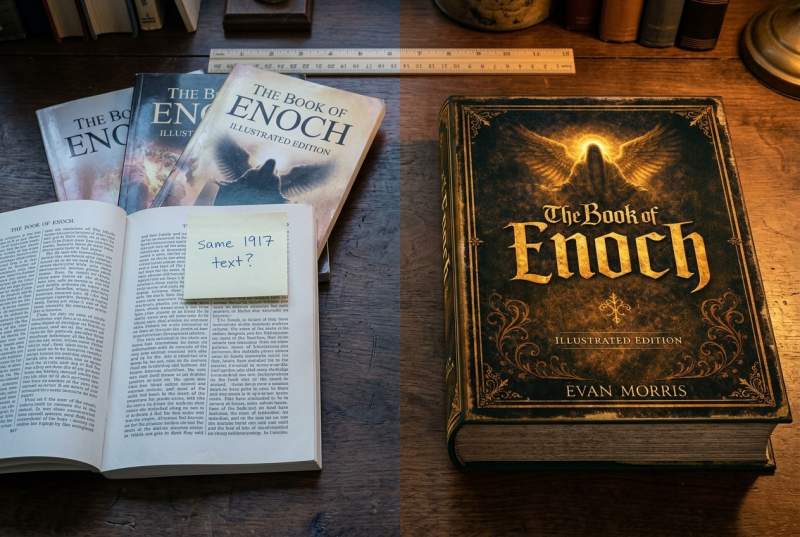
Before you go searching for the Book of Enoch, there is something you need to know. There are more than 50 editions of this text for sale right now. Most of them are the same book. Specifically: most are a repackaged version of a translation completed in 1917 by a scholar named R.H. Charles. His translation is in the public domain, which means any publisher can print it for free, slap a new cover on it, and list it as a new edition. Dozens have done exactly that. The covers are different. The prices vary from seven dollars to twenty-five. The text inside is identical — Victorian English prose written for an academic audience, dense with archaic constructions that modern readers find genuinely unreadable.
Verified reviews of these editions describe the experience in precise terms. There is also a leading competitor — currently ranked #1 in its category — whose author cannot be verified as a real person. The listing leads with suppression framing that, research consistently shows, produces theological anxiety in the very readers it is trying to attract. The text is not dangerous. But the wrong edition may mean you never actually read it. Know what you are evaluating before you choose.
I have had to use a dictionary and thesaurus to understand the ton of words I know not of.— Verified Amazon reviewer, R.H. Charles edition
That is not a one-star outlier. It is a documented failure pattern across multiple editions — buyers who came to this text with genuine curiosity and were defeated not by the content but by the formatting. A second reviewer put it plainly: "If you have ANY sort of depth perception issues, the text of this book will be unreadable." These are the editions your search results will serve you first.
The Math Nobody Does
Consider what you are actually looking for when you search for this text. You are not looking for a 1917 academic translation. You are not looking for a cheap paperback whose pages you will struggle to read under lamplight. You are certainly not looking for a pen-name author with no verifiable identity writing about texts that require real theological navigation. You are looking for the complete, readable text that explains what Genesis 6 left out, confirms what Jude was quoting, and gives you the interpretive framework that the biblical writers assumed their readers already possessed.
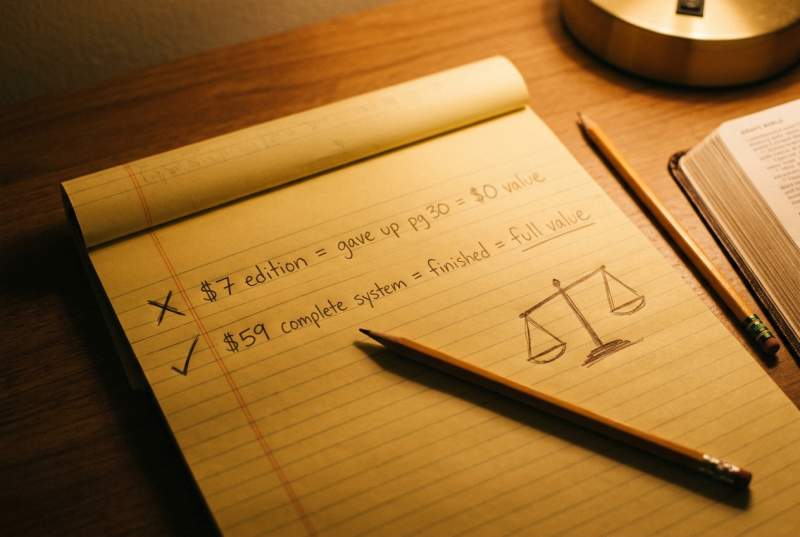
A $7 Amazon edition that you give up on after thirty pages costs you more than a $59 edition you actually finish — because the $7 edition delivers zero of what you came for. The question was never "which edition costs the least." The question has always been "which edition actually answers the question."
— Documented across verified reader reviews of commodity Book of Enoch editions, multiple platformsHere is what the readers who found an edition they could finish said: "No sleep last night. I was spellbound by the truth." Another: "It reads like an adventure of epic proportions." Another — one sentence that carries more weight than any marketing claim could: "It has lead me back to Yeshua/Christ after reading. I was an apostate." The text works. When it is readable. When it has context. When the gaps are labeled and filled. That is the version worth evaluating.
You are in that moment right now. See which edition is built to answer the question →
The Edition Worth Evaluating

The Book of Enoch – Illustrated Edition by Evan Morris is the version of this text designed to answer the question you actually have. It is not a repackage of the 1917 R.H. Charles translation. It is written in modern, readable English — the kind you can move through without a dictionary open in another tab. It includes 350+ pages of illustrated content, so the Watchers, the Nephilim, and the visions the text describes are not abstract — they are visible on the page.
It comes bundled with three exclusive study guides unavailable in any Amazon edition: The Watchers Explained, The Nephilim & Giants Codex, and Prophecies & End Times Breakdown — each one written specifically to map Enochic content back to the biblical passages it illuminates. The complete bundle — book, free audiobook, and three guides — carries a stated value of $116. The price is $59.
Three Things to Verify Before You Buy
Verify the Translation Source
Is this the 1917 R.H. Charles translation? Check the first chapter for archaic constructions — "thee," "hast," "wherefore." If you see them, you are holding the public-domain repackage. The Morris edition uses modern English. You will know within the first page.
Verify the Cross-Reference Content
The bonus guides — The Watchers Explained, The Nephilim & Giants Codex, Prophecies & End Times Breakdown — are exclusive to this edition. No Amazon competitor includes supplementary guides that map the text back to Genesis 6, Jude, or Revelation.
Verify the Jude Connection
Jude 14–15 is a direct New Testament quotation of 1 Enoch 1:9. This is not interpretation — it is a verified cross-reference in Scripture itself. Any edition worth your money should address this connection explicitly, not bury it in a footnote.
What Readers Say Before They Decide

These are not reviews of this specific edition. They are what readers who found a readable, contextually grounded version of this text say about the experience — the experience you are researching right now. None of these readers were academics. None were seminary students. They were Bible readers — exactly the kind of person who found the right edition, read it, and came out the other side with more faith and more understanding than they started with.
The Books of Enoch filled in a lot of blanks which the accepted Holy Bible left blank. It answers most of the questions Sunday School lessons didn't answer.— Jerimy Stoll, Goodreads; and a second Goodreads reviewer, independently
One voice captures the fear that stops many readers from getting here at all: "The more I explore apocryphal writings the more convinced I am that our version of Genesis is incomplete." And the outcome no one predicts: "It has lead me back to Yeshua/Christ after reading. I was an apostate." That outcome is what you are evaluating. See the edition that makes this possible →
Should I Be Worried About Reading This?
This is the right question to ask before you purchase. Here is what the evidence says. Jude 14–15 — inside your Bible, in the New Testament — directly quotes 1 Enoch 1:9. The apostle Jude cites this text by name. That is not interpretation. That is a verifiable cross-reference in Scripture itself. Fragments of the Book of Enoch were preserved among the Dead Sea Scrolls at Qumran — alongside the Hebrew Bible texts that would become the Old Testament.
The Book of Enoch remains part of the recognized biblical canon of the Ethiopian Orthodox Church today. Jim Hamilton, Professor of Biblical Theology at the Southern Baptist Theological Seminary, has publicly endorsed engagement with Enochic texts. The question is not whether this text has a place in Christian reading. The evidence answers that.
The question is which edition you choose to read it in. And if it doesn't answer these three things — Is it in modern English? Does it include cross-referenced study guides? Does it explicitly address the Jude connection? — you already know which edition does.