They Didn't Remove These Books Because They Were False. They Removed Them Because They Were Inconvenient.
A 40-year Christian just admitted he'd "never looked at them seriously until now." Before you buy any edition — here's what every honest collector needs to verify first.


It starts the same way for almost everyone. A verse catches your eye. Jude 1:14 — "Enoch, the seventh from Adam, prophesied..." Your Bible quotes a prophet. But when you flip to the index to find the Book of Enoch, it isn't there. You ask your pastor. He says those books were "deemed uninspired." He moves on.
Or someone mentions the Nephilim — the giant offspring of angels and women in Genesis 6. The text is right there in your Bible. But the story is four verses long and then it ends. As if someone deliberately stopped the explanation before it began.

Or you fall down a TikTok rabbit hole about the Gospel of Thomas — Jesus speaking in sayings so direct they feel like lightning. You screenshot it. You go looking for the source. And you find yourself on a Wikipedia page explaining that this gospel was deliberately excluded from the New Testament canon at the Council of Nicaea in 325 AD. By men. Not by God.
That is the moment this becomes personal. Not academic. Not historical. Personal. Because if those men had the authority to decide what you could and couldn't read — if your faith has been filtered through a political committee that met sixteen centuries ago — then the version of scripture you've held your entire life isn't the complete version. It's the approved version. And you are allowed to want more than that.
I don't know what politics was involved in eliminating these books, but I think they are certainly a must read for those of us who want to know the rest of the story. I am a Christian for about 40 years now and I have heard about the lost books, but until recently, I haven't looked at them seriously until now.— Verified Amazon Reviewer, Ultimate Apocrypha Collection
That phrase — the rest of the story — is why you're here. Not because you've lost your faith. Because you've had enough of it to ask harder questions. Before you spend a dollar on any edition, though, you need to understand how the market for these books is set up to disappoint you. Intentionally or not.
Warning: "Complete" Is the Most Misleading Word in This Category

Here is what you will encounter when you start searching for these texts on Amazon. You will find dozens of editions — 54 books, 70 books, 100 books, 180 books, even 300 books — each one calling itself "complete." Each one containing a different set of texts. No two are the same. And most of them won't let you preview a single interior page before you buy.
Here is the problem you cannot see from the listing: The most popular "complete" apocrypha collections — including those from the dominant brand in this category — deliberately exclude the Gnostic gospels from every single edition they publish. Including their flagship 300-book version. This is not an oversight. It is an editorial decision. The Nag Hammadi Library, the Gospel of Thomas, the Gospel of Philip — the texts that were buried in the Egyptian desert in 1945 and represent the earliest surviving Christian writing — are simply absent.
When it says 'The Complete Apocrypha'… that's not entirely correct either. Anything that could be labeled as gnostic is missing.— Verified Amazon Reviewer, Covenant Press Complete Apocrypha (Kindle edition)
This is not a fringe complaint. This is the documented pattern of the category. And the print editions that do attempt to include everything often compress thousands of pages into a few hundred — creating a text so small that 69% of print-size mentions across apocrypha editions on Amazon are negative, per Amazon's own AI review summary. Before you buy anything, you need a way to verify what's actually inside. We'll show you exactly how to do that.
The Math Nobody Does Before Buying

Let's run the numbers on what most people actually spend before finding one complete source. A standalone Book of Enoch: $12–$18. A Nag Hammadi Library paperback: $20–$35. A 54-book edition: $25–$40. A larger 100-book compilation because the 54-book was missing the Gnostics: $30–$50. A separate Book of Jubilees. A standalone Gospel of Thomas. The Ethiopian Orthodox canon. By the time most serious readers reach a comprehensive reading list, they have spent $80 to $150 across five or six separate purchases — and still have gaps. Still no audiobook for long drives. Still no guide explaining the historical context of what they're reading. Still no answer to the question: "Is this actually everything, or am I still missing something?"
The fragmented bookshelf is not a personal failure. It is how this category is structured. Publishers have a financial incentive to sell you five incomplete books rather than one complete one. That is why the most important question to ask before any purchase is not "How many books does it contain?" It is: "Can I verify what's inside before I commit?"
— Pattern documented across competing editions on Amazon; verified by buyer review dataThe next section shows you a four-point verification checklist — four specific things you can check on any edition before spending a dollar.
Most buyers skip this entirely. That's how they end up with a book too small to read, a "complete" collection missing an entire library of Gnostic gospels, and a shelf full of partial answers. See how The Lost Apocrypha Bible answers all four verification tests →
How to Verify Any Apocrypha Edition Before You Buy
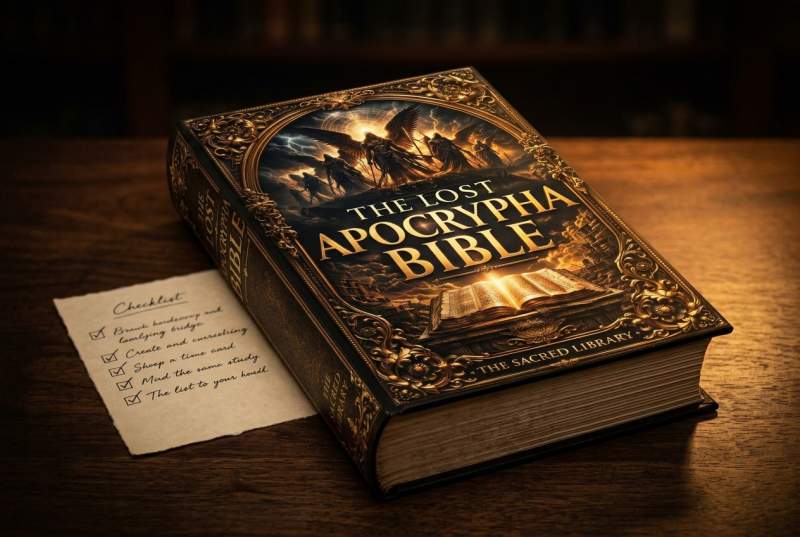
Most editions won't let you preview the interior. Here are the four things you can check from the outside — and how The Lost Apocrypha Bible answers each one.
The Gnostic gap is the single most important test. The Nag Hammadi Library and the Gospel of Thomas must be named in the table of contents or the product description. If the listing only says "Gnostic texts" without specifying which ones, assume they're absent. Confirmed buyers have documented this omission in print. Next, calculate the compression ratio: divide the digital page count by the paperback page count. A ratio above 5:1 is a warning sign for unreadably small print. The most popular 180-book edition compresses 4,066 digital pages into 547 paperback pages — a 7.4:1 ratio that almost certainly produces the tiny-font experience documented in 69% of print-size reviews. Then check for context and guidance materials — any edition serious about the reader's experience will include study guides, historical context, or a reader's introduction. No competing print compilation includes these. Finally, confirm the risk reversal: can you return it, with no questions, for how long?
Four Verification Steps Before Any Purchase
Verify Gnostic Inclusion
The Nag Hammadi Library and Gospel of Thomas must be named explicitly. "Gnostic texts" without specifics means they're likely absent.
Check Compression Ratio
Divide digital pages by paperback pages. A ratio above 5:1 almost always means print too small to read comfortably.
Confirm Study Guides
Ancient texts are disorienting without context. Any serious edition includes historical introductions or companion materials — not just raw text.
What Serious Readers Are Saying Before They Decide
The question we hear most often from people researching this edition is some version of: "Is this really different, or is it the same disappointment in a nicer package?" It is a fair question. This category has earned that skepticism. Here is what the verified reading experience data tells us about what happens when someone actually encounters these texts — regardless of edition:
I was shocked and fascinated by this book. It's really exciting to be able to see what the first to second century Christians believed and how they perceived Christ.— Verified Amazon Reviewer, Lost Scriptures
These are not reactions to a catalog. These are reactions to the texts themselves. Ancient writing that was suppressed for over a thousand years — writing that hits with the force of a spiritual encounter when you finally encounter it in a readable, complete, guided format. One reader described how the Adam & Eve book "made me cry — I just could not bear the thoughts of seeing them standing in the cave. All alone and in desperate need of God and his presence." Another said the Nag Hammadi Library "opened up 'a new world' to me." The question is not whether these texts will move you. The verified record says they will. The question is whether the edition you choose lets you access them clearly — or buries them in print too small to read.
The difference between an encounter and a disappointment is the edition. Claim your copy of The Lost Apocrypha Bible with a 30-day guarantee →
"Why Pay $59 When I Can Find These Texts Free Online?"

You can. The Nag Hammadi Library is available at gnosis.org. The Book of Enoch is on sacred-texts.com. These are public domain translations. What you are paying for is not the content — you are paying for the assembly.
Right now, reading these texts in a coherent, complete sequence requires navigating at least six separate websites with inconsistent formatting, no cross-referencing, no historical context, and no physical ownership. You cannot annotate a webpage. You cannot hand a webpage to someone you love and say, this is what I want you to read. The Lost Apocrypha Bible bundles the texts, a full audiobook, and seven companion guides into one verified, readable, guaranteed system — for $59, with a 30-day return window if it isn't everything described.
The free option is always there. The question is whether scattered and free is what you actually want.