A New Testament Author Quoted a Book That Isn't in Your Bible. Most People Never Ask Why.
The Epistle of Jude cites an ancient text by name — word for word, as prophecy. That text has been preserved for roughly 2,000 years by one of the oldest Christian traditions on earth. Here's what that tradition kept, and what most Western readers have never seen.


Open a copy of the Epistle of Jude — one of the shortest books in the New Testament, tucked near the end — and read verse 14. It begins: "Now Enoch, the seventh from Adam, prophesied about these men also, saying, 'Behold, the Lord comes with ten thousands of His saints.'" The attribution is specific. The quotation is direct. A New Testament author is citing an ancient figure's words as prophecy, treating them as authoritative, weaving them into a canonical letter that has been read in Christian churches for roughly 2,000 years.
There is one question most readers never pause to ask: where is the rest of what Enoch said? The answer is not in the Bible most Americans own. It was preserved, in full, by a different branch of Christianity — a tradition that has been holding its version of the sacred library largely intact since the first centuries of the faith.
The story of what that tradition kept, and why the Western church holds a different collection, is one of the more quietly remarkable chapters in Christian history. It begins in a country most Americans associate with distance rather than doctrine.
The Ancient Library That Kept What Others Set Aside
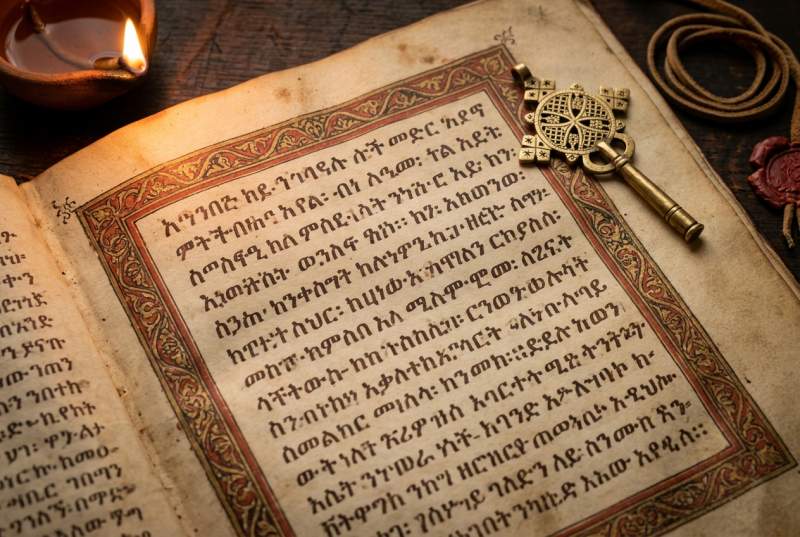
The Ethiopian Orthodox Tewahedo Church is among the oldest continuously practicing Christian denominations in the world. Christianity arrived in the region during the 4th century, and the church's scriptural tradition took shape during the same early centuries when the Western canon was still being debated, refined, and contested at various councils. The Ethiopian tradition did not make the same exclusions that the Western tradition eventually formalized. It kept a broader library.
In the version of the Bible held by this tradition, there are books that Western readers have never encountered in a church pew, a Sunday school class, or a seminary course. There is the Book of Enoch — the same text Jude cited. There is the Book of Jubilees, a detailed retelling of Genesis that fills in genealogies and timelines the standard text leaves open. There are the Meqabyan, three books of a distinctly Ethiopian tradition with no close Western equivalent. There are texts quoted by early Church fathers, referenced in theological debates from the first five centuries, and then quietly absent from most Western editions by the medieval period.
The total count, depending on how the tradition is tallied, runs to somewhere between 81 and 88 books — compared to the 66 in the Protestant Bible most Americans read.
The curiosity is genuine and widespread. The material to satisfy it has been harder to find — and harder to find in a form that is actually readable — than it should be.
What Was Kept, What Was Set Aside, and Why the Difference Matters

The question of which books belong in the Bible is not new. It was actively contested for several centuries in early Christian history — different regional traditions making different decisions, different councils drawing different lines. The Western church, through the medieval period and accelerating with the Protestant Reformation, settled on a shorter canon. The Ethiopian tradition, relatively isolated from those institutional pressures, preserved a longer one.
Most American Christians are aware, in a general way, that there are "other books" — texts sometimes called the Apocrypha, sometimes called "the lost books." What they are less aware of is that these books did not disappear. They were not burned, suppressed, or scattered. They were maintained, copied, read, and taught by millions of Ethiopian Christians whose tradition simply never made the same cuts that the Western tradition did. The Book of Enoch — the text Jude quoted by name — has been a continuous part of their canon for approximately 2,000 years.
For Western readers who have noticed Jude's citation and gone looking for the full text, the search has historically ended in one of two places: a standalone edition of Enoch in archaic 19th-century scholarly language, or a broad "expanded Bible" that includes the Western apocrypha but stops short of the distinctly Ethiopian texts like Meqabyan and the complete version of Jubilees.
I am on a journey of truth for my soul that is only judged by God and not a church.— Reader, Orthodox Christian Laity forum
The curiosity is genuine and widespread. The material to satisfy it has been harder to find — and harder to find in a form that is actually readable — than it should be.
A Tradition That Never Lost the Thread

The Ethiopian Orthodox Tewahedo Church's claim to antiquity is not rhetorical. The Garima Gospels, held at Abba Garima monastery in northern Ethiopia, are among the oldest surviving Christian manuscripts in the world. The liturgical language of the church — Ge'ez — is an ancient Semitic script that predates Arabic and carries within it a textual tradition that has been recited, debated, and transmitted by priests and scholars for century upon century without significant interruption.
When scholars and historians examine the books that Jude, Peter, and other early Christian writers appear to reference — texts that are not in the standard Western canon but seem to be in the background of New Testament thought — they often find them intact in the Ethiopian tradition. The Book of Enoch, in particular, shows clear evidence of having been known and cited by multiple early Christian writers. Its preservation in Ethiopia is not an accident of geography. It is the result of a theological tradition that never agreed it should be set aside.
For the majority of American Christians, this tradition is essentially invisible — not because it is obscure in the world, but because very little of it has been made accessible in English. The Ethiopian Orthodox Church has millions of adherents. Its liturgical texts, its commentaries, its full biblical canon: most of that exists in Ge'ez, Amharic, and Tigrinya. The body of work has simply not crossed the language barrier at scale.
Until recently, an English reader who wanted to read what Jude read — the full text of Enoch, in context, alongside the other books the Ethiopian tradition preserved — had no single reliable source to turn to.
This is what biblical historians and scholars of early Christianity have been pointing toward for years. See what we found →
Since this article was first published, our editorial team received hundreds of messages from readers asking where they could find a complete English edition of the Ethiopian biblical canon — one that included the texts described above, in a format that was actually readable. We reviewed the available options and found a category-wide problem: virtually every edition making this claim had been called out for serious editorial defects. One edition stood out as different. We are noting it below as a service to readers who have been searching.
The Edition Our Editors Found

After reviewing the landscape of available English editions — a process our team undertook in response to reader inquiries — the picture that emerged was consistent: the category has a serious quality problem. The Ethiopian Orthodox Bible Project, the most authoritative English-language voice on this subject, has documented that every "complete" English Ethiopian Bible currently available is incorrect in some material way — missing books, duplicated chapters, misspelled proper names, typography that is physically difficult to read. One verified buyer found the same chapter text printed three times. Another found a single character's name spelled four different ways across the same volume. The promise of completeness and the delivery of it have been, in this category, persistently different things.
The Ethiopian Bible — Complete 88 Books is the edition our team identified as having addressed the problems documented above. It is built as a hardcover volume with genuine attention to the physical experience of reading — not a single-volume telephone-book format, but designed for the reader who intends to actually spend time with the text, not merely own it.
The edition includes the full range of books the Ethiopian tradition has preserved, among them the complete text of 1 Enoch — the book Jude cited in verse 14 — alongside Jubilees, the Meqabyan, and the other texts that distinguish the Ethiopian canon from both the standard Protestant Bible and the broader Western apocrypha collections. The editorial approach is deliberately non-doctrinaire. The book does not argue for a theological position. It does not tell the reader what to believe about the texts it contains. It presents the fuller library and trusts the reader to engage with it.

- ✓Complete 88-book canon — from the Ethiopian tradition, including texts unavailable in any Western collection
- ✓Full text of 1 Enoch — the book Jude cited by name in verse 14, included in full, in context
- ✓Non-doctrinaire presentation — presents the texts without arguing a theological position, trusting the reader to engage
What Readers Are Discovering

The response pattern among readers who have found a complete, readable edition of the Ethiopian canon follows a recognizable arc. The starting point is almost always curiosity triggered by a single reference — often Jude's citation, or the Mel Gibson comments about the Ethiopian Bible that spread widely in early 2026, or a YouTube video about the Book of Enoch. The first encounter with the full text tends to deepen the question rather than close it: Enoch, in full context, raises questions about Jubilees, which raises questions about the Meqabyan, which raises questions about what else the Ethiopian tradition held that the Western tradition set aside.
I found with Enoch that his words were exciting to my spirit and it reads like an adventure of epic proportions.— Goodreads reader
The Book of Enoch, it turns out, is not a brief curiosity. It is a sustained narrative — angels, cosmic architecture, prophecy, judgment — that many readers describe as reading unlike anything else in the scriptural tradition. In the Ethiopian canon, it sits in context alongside the other texts, rather than in isolation as a standalone edition. The difference between reading it alone and reading it as part of the fuller library is, by many accounts, significant. See the edition →
One Question Most People Have Before They Begin

For many American Christians, the hesitation before engaging with the Ethiopian canon is not intellectual — it is theological. The question takes a specific form: Is it a sin to read texts that aren't in my Bible? Is this heresy?
It is worth noting that this concern has a direct answer from within the New Testament itself. The Epistle of Jude — a canonical book, accepted in every major Christian tradition — cites the Book of Enoch in verse 14 by name, treating its words as prophecy. If reading Enoch constituted theological transgression, that transgression was endorsed, in writing, by a New Testament author whose letter is in every Bible. Ligonier Ministries, one of the most respected Reformed theological organizations in the United States, has explicitly endorsed reading Enoch for biblical context.
The Ethiopian Bible — Complete 88 Books does not argue a theological position. It does not tell the reader what to believe. Its approach is non-doctrinaire: it presents the fuller canon and trusts the reader to bring their own faith and discernment to the text. The appropriate question is not whether to read it, but which edition is worth reading. For readers who arrive with genuine faith and genuine curiosity, the edition comes with a full satisfaction guarantee — if it is not what you were looking for, return it.

The Book of Enoch: Why a New Testament Author Quoted a Text Most Christians Have Never Read
7 min read
What the Early Church Read: The Books That Shaped Christianity Before the Canon Was Formalized
8 min read