7 Reasons The Ethiopian Bible: Complete 88 Books Is The Edition You've Been Looking For Since Jude Quoted Enoch
Every "complete" Ethiopian Bible you've seen makes the same promise — and breaks it the same way. One edition doesn't. And it's the one a New Testament author already vouched for.

You are not reading this because you're new to this search. You've already bought one — maybe two — editions that claimed to be complete and weren't. The print was unreadable. The text was duplicated. The digital bonus was a QR code that led nowhere. You know what the Ethiopian Bible is supposed to contain. You just haven't found the version that actually contains it. That changes here.
Every Ethiopian Bible you've bought promised 88 books, readable print, and complete text. None delivered — and this isn't speculation. The Ethiopian Orthodox Bible Project, the most authoritative English-language voice on Ethiopian biblical texts, has stated publicly that every "complete" English Ethiopian Bible on the market is "incorrect… most of them are in very tiny print, riddled with typos and appear hastily assembled."
That condemnation covers the $27 Amazon paperback with the repeated chapters. The $35 print-on-demand edition with the eight-point font. The one with the broken QR code. All of them.
The Ethiopian Bible: Complete 88 Books is the edition that exists specifically because that statement is true — and because the buyer who has been through two or three of those failures deserves something built differently.
"Finally the complete Ethiopian Bible I was looking for, as others I have ordered did not all of the Books."
— Verified Buyer, January 28, 2026
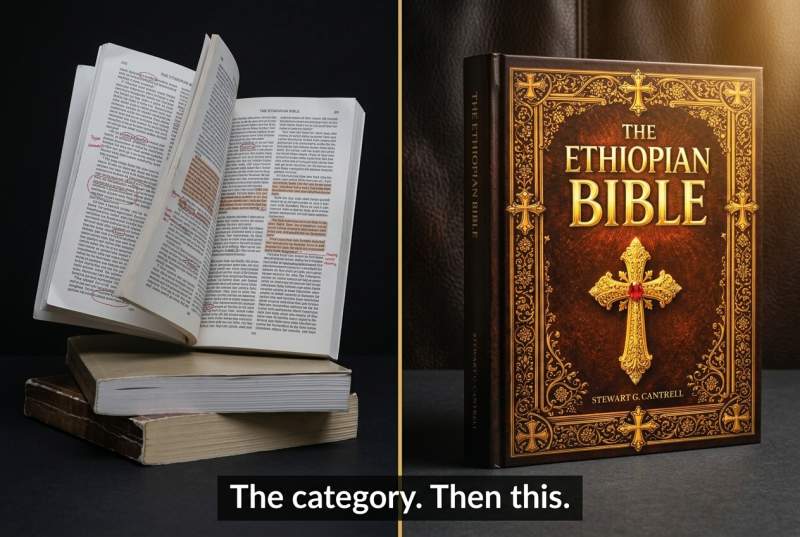
The #1 reason people hesitate before buying an Ethiopian Bible isn't price. It's fear. "Is it a sin to read this? Is the Book of Enoch heresy?"
Here is the only answer that matters: Jude 1:14–15 (NKJV) — a letter in your New Testament, written by an apostle — directly quotes the Book of Enoch as prophecy.
"Now Enoch, the seventh from Adam, prophesied about these men also, saying, 'Behold, the Lord comes with ten thousands of His saints.'" — Jude 1:14 (NKJV)
The text Jude cited is in this edition. In full. Jude did not treat it as forbidden literature. He treated it as scripture. If a New Testament author cited it as prophetic truth, the permission question was settled before any modern seller could manufacture a controversy around it.
No other Ethiopian Bible edition makes this case. They hedge. They say "does not seek to redefine doctrine." This edition makes the affirmative argument — because the Bible already made it for us.
"My experience in suggesting the book as valuable reading material to Christians has been met with skepticism. Many people think, 'The book of Enoch? Oh no, I only follow the Bible.'" — Talk Jesus Forum
That person had never been shown Jude 1:14.
Every Ethiopian Bible on the market claims completeness. The Ethiopian Orthodox Bible Project says they are all lying.
The problem isn't malice. It's that "88 books" is a claim that requires transparency to be credible — and no competitor provides it. The Ethiopian Orthodox Tewahedo Church's official canon lists 81 books. English editions claim 88. Nobody explains the difference. Nobody shows the table of contents up front. Nobody tells you which seven books create the discrepancy, or why.
This edition addresses the discrepancy directly: the 81-book narrow canon and the 88-book broader canon both have historical precedent within the Ethiopian tradition. The seven additional books — including texts like 1–3 Meqabyan — represent the broader, historically attested Ethiopian canon that is not universally codified at 81. You get the explanation, not just the claim.
You also get what the Covenant Press 54-Book Apocrypha does not: the uniquely Ethiopian texts. Meqabyan, the full Ethiopian context for Jubilees, and the texts that belong specifically to this tradition — not just the broader deuterocanonical collection every apocrypha compilation includes.
"I recommend this Bible to anyone that wants to know the full truth… things that have been taken out…"
— Verified Buyer, January 8, 2026

The edition Jude's citation points to. 88 books. Built for the reader who's been through the alternatives.
See What's Actually Inside →The #1 physical complaint across every Ethiopian Bible review on every platform is the same: telephone book. One volume. Thousands of pages. Eight-point font. A book you own but cannot use.
This edition is organized so the text is actually readable. Not as a marketing claim — as a physical reality. The books are grouped, the sections are navigable, and the format is designed for someone who intends to read the complete canon, not display a monolith on a shelf.
"Its telephone book size and girth is daunting, as is its small print (despite so-called large print)."
— Goodreads Reviewer
That was a different edition. The distinction is intentional.

The math on the Ethiopian Bible buyer's purchase history is unflattering. A standalone Book of Enoch: $5–$15 — archaic 1905 Charles translation, one text, no context. A budget "complete" Ethiopian Bible on Amazon: $27–$50 — typos, duplicated chapters, missing books. Possibly the Covenant Press Apocrypha: ~$33 — well-made, but it stops at 54 books and misses the uniquely Ethiopian texts entirely.
Total spent on editions that didn't work: $50–$150+.
The Ethiopian Bible: Complete 88 Books starts at $59 — a single purchase that costs less than most buyers have already wasted on the category. The $79 bundle and $109 premium tiers are positioned alongside the Orthodox Study Bible and the Cepher, both of which charge $55–$95 for adjacent premium editions with years of trust behind them.
The price is a signal. In a category where everything is priced to be disposable, a premium price tied to demonstrable quality tells you something.

Print-on-demand paperback is the delivery mechanism of every $27–$50 Ethiopian Bible on Amazon. It exists because it is cheap to produce and profitable to sell at a margin. It is not built to be read, annotated, passed down, or treated as a serious volume.
This edition is a hardcover. The binding is constructed to survive repeated use. The cover boards are rigid. The spine does not crack at page 200. You can open it flat on a table without the pages fighting you. This is the physical format a text of this significance deserves — and that no Ethiopian Bible currently on the market delivers at this tier.
"I found with Enoch that his words were exciting to my spirit and it reads like an adventure of epic proportions."
— Goodreads Reviewer
An adventure of epic proportions deserves a book built to hold it.

If you have bought one Ethiopian Bible that disappointed you, you've already spent $27–$50. If you've bought two or three — which the data says most buyers in this category have — you've spent $50–$150+ on editions the Ethiopian Orthodox Bible Project has publicly called incorrect.
At $59, the single edition of The Ethiopian Bible: Complete 88 Books costs less than what most buyers have already lost to defective copies. And unlike every edition you've previously purchased, this one comes with a 30-day money-back guarantee.
You read it. You compare it. You hold it. If it does not deliver what this advertorial promised — complete text, readable format, the edition that includes what Jude cited — you get your money back. No forms. No friction.
The editions that burned you before offered no guarantee. They didn't need to. They were banking on you not bothering to return them. This is different.
"I am on a journey of truth for my soul that is only judged by God and not a church."
— Orthodox Christian Laity Forum Reader
That journey deserves a guide you can trust. And a safety net if it isn't.

How It Compares To Every Alternative
The one with the Jude citation. The hardcover. The guarantee. The edition the category has been missing.
Try It Risk-Free →Is The Ethiopian Bible: Complete 88 Books Right For You?
- You've already bought one or two Ethiopian Bible editions that disappointed you — you know the category's failure modes and you're done gambling on another $35 paperback
- You've been hesitant to read Enoch because someone told you it was heresy — Jude 1:14–15 is in your New Testament, and this edition gives you the context to read it
- You want the uniquely Ethiopian texts — Meqabyan, the full canon — not just the standard deuterocanonical books every apocrypha collection covers. The Covenant Press stops at 54 books. This doesn't.
- You want a physical book built to be read, annotated, and kept — not a print-on-demand paperback that cracks at the spine and prints at eight-point font
- You're looking for the cheapest possible entry into the Ethiopian Bible — the $27–$50 Amazon editions exist. They have the documented defects. If price is the only variable, this isn't for you.
- You want a purely academic, footnoted study edition with full scholarly apparatus — this is the complete canon, readable and well-formatted. It is not the Oxford Annotated or the Orthodox Study Bible.
- You're not ready to engage with a canon that goes beyond the 66 books you grew up with — the expanded canon asks questions that the standard edition left unasked. Wait until you are.
In a category the Ethiopian Orthodox Bible Project has publicly condemned as universally defective, The Ethiopian Bible: Complete 88 Books enters as the edition built specifically for the reader who has exhausted the alternatives. The Jude 1:14–15 endorsement resolves the #1 pre-purchase objection before the buyer asks it. The canonical transparency addresses the bluff every competitor is running. The hardcover construction answers the telephone-book complaint documented across every review platform. At $59, it costs less than most buyers have already lost to the editions it replaces.
