Before You Read the Book of Enoch — A New Testament Author Already Did
Jude 1:14 quotes the Book of Enoch as prophetic truth. Yet most Christians have been told it's forbidden. Here's what that means for you — before you spend another dollar on an edition that may not even contain it correctly.


You've probably heard it by now. Maybe it was a YouTube video about fallen angels. Maybe it was someone on Reddit explaining that the Bible used to have more books. Maybe it was the Mel Gibson interview circulating on social media in early 2026 — the one where he talked about the Ethiopian Bible preserving texts that the Western tradition quietly removed.
However you got here, you've arrived at the same question that millions of American Christians are sitting with right now: Is something missing from my Bible? You already suspect the answer is yes.
The Book of Enoch keeps coming up. You've seen references to it — Nephilim, fallen angels, the Watchers, the cosmic trial, the description of heaven that reads nothing like the sanitized version you grew up with. Every time you look it up, the story gets more interesting. And every time you get close to reading it, someone — a pastor, a church friend, a well-meaning relative — pulls you back. That book isn't in the Bible for a reason. Be careful. Some things are hidden for a purpose.
So you hesitate. And here is where most people in your position make a decision that costs them money and trust. They either suppress the curiosity — which never works, because it keeps resurfacing — or they go to Amazon and buy the cheapest edition with "Complete" in the title. They trust the cover. They trust the listing. They assume that if it's for sale, it must be what it claims to be.
Before you do either of those things, there's something you should know. Not about this product. About a man named Jude — and a single verse he wrote roughly 2,000 years ago — that changes the entire frame of the decision you're about to make.
The Warning Every Amazon Listing Buries in the Fine Print
Here is the warning that every listing on Amazon buries in the fine print — or never mentions at all. The Ethiopian Orthodox Bible Project, the most authoritative English-language voice on Ethiopian biblical texts, has issued a finding that should stop you before you click "Add to Cart" on any cheap listing: every "complete" English Ethiopian Bible currently on Amazon is incorrect. Their words, not ours. Riddled with typos. Hastily assembled. In very tiny print.
That's not a marketing claim from a competitor. That's a documented indictment of the entire category. A verified Walmart buyer in January 2026 described what they received inside one of the bestselling "complete" Ethiopian Bibles: "In Jubilees, the same chapter text was repeated 3 times... 1 Enoch has Semjaza spelled 4 different ways." Four different spellings of a single angel's name. Chapters printed three times. In a book you may have been considering purchasing this week.
Its telephone book size and girth is daunting, as is its small print (despite so-called large print).— Goodreads reader reviewing a leading "complete" Ethiopian Bible edition
And there's a third failure pattern you need to know about before you see it for yourself: a verified Walmart buyer in February 2026 reported that the promised "digital bonus" in a leading edition sent them to a QR code that directed them to download a messenger app. No audio. No video. No content. Just a redirect to an app with no connection to the product. These are not edge cases. These are the documented buying experiences of people who were exactly where you are right now — researching, curious, ready to invest — and who trusted the "Complete" label on the cover. Before you spend another dollar, understand what "complete" has meant in this category until now.
Before We Talk About Any Product — Let's Talk About Jude

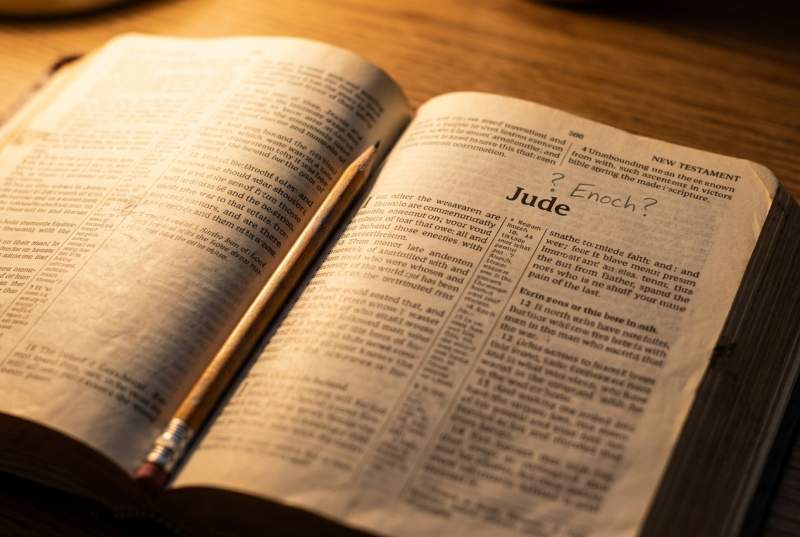
Not the Judas you're thinking of. Jude. The author of the second-to-last book in your New Testament. The man tradition identifies as the brother of Jesus. The man who wrote 25 verses and had them included in the canon of Scripture your church has read for centuries. In verse 14 of his letter, Jude wrote something that most modern Christians have never been told.
"Enoch, the seventh from Adam, prophesied about these men, saying, 'Behold, the Lord comes with ten thousands of His saints, to execute judgment on all...'" — That is a direct quotation from the Book of Enoch, chapter 1, verse 9. Jude did not hedge. He did not say "as the ancient text claims." He cited Enoch as a prophet and quoted his words as prophetic truth — the same way any biblical author cites a text they consider authoritative.
— Jude 1:14–15 (NKJV). Cross-referenced against 1 Enoch 1:9. Verified.Your Bible contains Jude's endorsement of Enoch. It does not contain the text he endorsed. That is the paradox you are living with. And now that you've seen it stated plainly, the question is not whether it's legitimate to read the Book of Enoch. The question is: where do you find a complete, readable, trustworthy edition that actually includes it — along with the other 21 books the Ethiopian tradition preserved?
If you're ready to evaluate a premium edition built to answer that question, view The Ethiopian Bible — Complete 88 Books
How This Edition Compares — What to Verify Before You Buy

The Ethiopian Bible — Complete 88 Books is a premium hardcover edition available , built for the reader who has done the research, understands what the category has failed to deliver, and is ready to own an edition built to a different standard.
Before you purchase any edition in this category — including this one — here is how to evaluate what you're considering against the alternatives. The comparison below is built on verified buyer complaints, documented editorial failures, and the single most important legitimacy test the data identified: whether the Jude 1:14 argument has been addressed at all.
3 Verification Steps — Use These Before Buying Any Edition
Check the Table of Contents First
Any edition that won't show you every book listed before you pay is hiding something. The Ethiopian Orthodox Bible Project confirms every "complete" claim in this category is contested. See the full list first — then decide.
Look for the Jude Argument
If an edition claims to include the Book of Enoch but doesn't address Jude 1:14, they haven't thought about why Enoch matters — or they're hoping you haven't either. Biblical legitimacy should be documented, not assumed.
Request a Sample Page
Font size, formatting, and print quality cannot be confirmed from a cover photo. The #1 physical complaint in this category — confirmed across multiple platforms — is unreadable print. A trustworthy seller will show you what's inside before you pay.
What Readers Who Searched for This Edition Were Already Saying

The buyers currently researching Ethiopian Bible editions are not first-timers. They have been through this before. Here is the documented language of the buyers who exist in this category right now — before they found an edition that delivered. On what they were looking for: "Finally the complete Ethiopian Bible I was looking for, as others I have ordered did not all of the Books." (Walmart verified buyer, January 28, 2026.) On why they kept buying: "I recommend this Bible to anyone that wants to know the full truth... things that have been taken out." (Walmart verified buyer, January 8, 2026.)
I found with Enoch that his words were exciting to my spirit and it reads like an adventure of epic proportions.— Goodreads reader, on finally reading the Book of Enoch in full
These are not people who found what they were looking for on the first try. These are people who kept searching because the need was real — and kept failing because the products weren't. The reader profile for The Ethiopian Bible — Complete 88 Books is built for exactly this buyer: the one who is done settling. If that's you, view the full edition and what's inside
"But Isn't Reading the Book of Enoch a Sin? What If My Church Says It's Off-Limits?"

This is the most common question from readers researching this edition — and it deserves a direct answer before you purchase. The answer is not from us. It's from your New Testament.
Jude 1:14–15 (NKJV) records a New Testament author quoting the Book of Enoch as prophetic truth. Jude did not hedge, qualify, or distance himself from Enoch. He cited Enoch the way any biblical author cites a text they consider authoritative. Ligonier Ministries — one of the most respected Reformed theological institutions in the United States — endorses reading Enoch for historical and biblical context. "I am on a journey of truth for my soul that is only judged by God and not a church," as one reader on Orthodox Christian Laity put it. That orientation — curiosity without denomination — is exactly the reader this edition was built for.
Your Bible contains Jude's endorsement. The Ethiopian Bible — Complete 88 Books contains the text he endorsed. If Jude had permission, so do you.