The Weekly Conversations That Keep Your Teenager's Faith Alive
A full-year discipleship system that turns "I don't know what I believe" into "Let me tell you exactly why I believe it." You already know the statistics — 64% of kids raised in church walk away by their late twenties. And 53% made that decision before they turned 18.

This isn't another devotional that'll get abandoned after three weeks. It's a 52-week discipleship system — designed to create the kind of structured, weekly faith conversations that research shows are the single strongest predictor of whether your teen still believes at 25.
- ✔ 52 weeks of real theology — doctrine, apologetics, and critical thinking broken down so your teen actually understands it
- ✔ Parent & Leader Guide included — weekly conversation frameworks so you don't need a seminary degree
- ✔ Apologetics Cheat Sheets — printable answers to the hard questions your teen is already Googling
- ✔ 52-Week Faith Tracker — reflection prompts and spiritual growth checkpoints that build momentum
- ✔ Audiobook version included — so your teen can engage during car rides, commutes, or downtime
- ✔ Youth Group Curriculum Pack — lesson outlines and group activities for churches, co-ops, and small groups
Most Parents Get This Wrong — And It's Costing Their Teen's Faith
Here's what most Christian parents do when they realize their teenager's faith is slipping:
They buy a teen devotional. Something with a nice cover, short daily readings, maybe some fill-in-the-blank questions. It arrives. Their teen opens it once. Maybe twice. Within three weeks, it's on the shelf next to the last one that didn't work.
And it's not because their teen is lazy or rebellious. It's because most teen devotionals are fundamentally broken.
As one ministry leader put it bluntly: "Most teen devotionals stink! Not some, not many, MOST of them." They talk down to teenagers like they're eight years old. The application always boils down to the same thing: "Now go be nice and good for Jesus."
So then the parent tries the opposite — a serious theology book. Grudem's Systematic Theology. Something with real substance. One youth pastor described the result: "I taught straight out of Systematic Theology by Wayne Grudem... Needless to say, things didn't exactly work out."
Too shallow doesn't work. Too deep doesn't work. And in between? The parent falls back on the default: just keep taking them to church and hope it sticks.
But here's the hidden consequence no one talks about:
Every failed attempt teaches your teen the same lesson — that faith is either boring, confusing, or irrelevant. Each devotional that gets abandoned, each dinner-table Bible study that turns into an argument, each Sunday morning that becomes a battleground — it doesn't just fail to help. It actively pushes your teen further away.
By the time most parents realize the approach isn't working, they've already trained their teen to tune out.

What If the Book Wasn't the Point — And the Conversation Was?
Here's what the research actually says about teen faith retention — and it's not what most parents expect:
The single strongest predictor of whether your teenager still believes at 25 isn't what book they read. It's whether they had regular, structured faith conversations with a parent.
Pew Research (2025) found that 82% of teens raised in highly religious homes — where faith was actively discussed, not just passively modeled — retained their faith into adulthood. Compare that to just 47% in homes where religion was present but not actively engaged.
Lifeway Research confirmed it: when a teen has 3 or more invested adults having real faith conversations with them, their odds of dropping out of church drop by 2.65x.
The problem with devotionals isn't that they're too short or too long. It's that they hand your teen content and walk away. There's no conversation built in. No framework for the parent. No bridge between "here's what the Bible says" and "let's talk about what this means for your life."
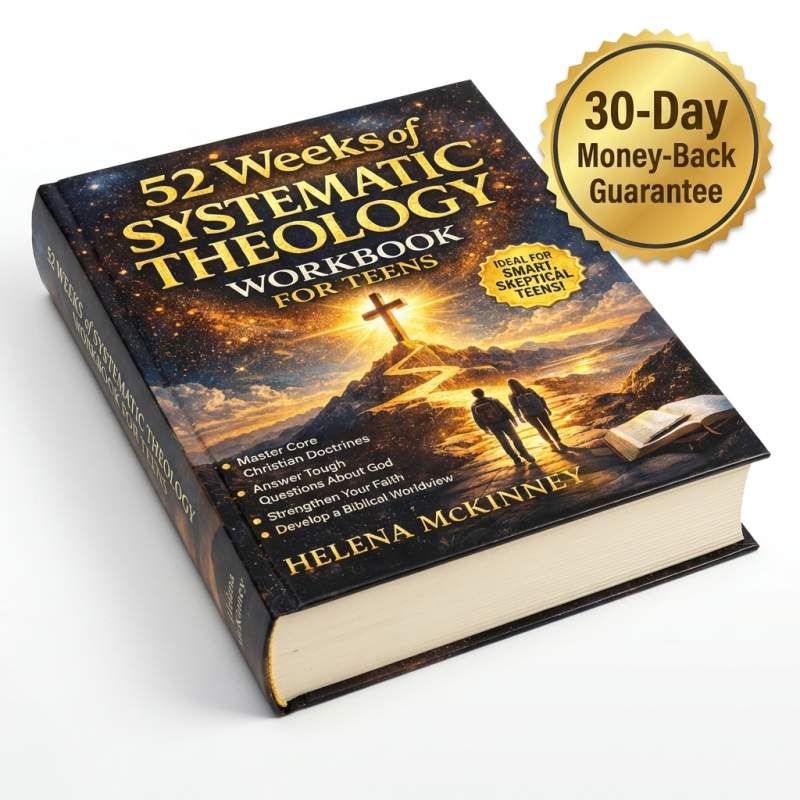
Helena McKinney's 52 Weeks of Systematic Theology Workbook for Teens was designed from the ground up as a conversation system, not just a curriculum.
Every week, your teen works through real theology — doctrine, apologetics, critical thinking — at a level that respects their intelligence without overwhelming them. And every week, the included Parent & Leader Guide gives you the exact conversation framework to turn that lesson into a meaningful discussion.
You don't need a seminary degree. You don't need to have all the answers. You need a structured reason to sit down with your teen once a week and talk about what they actually believe — and a guide that shows you how.
This is that system.

Why This System Exists (And Why You Can Trust It)
Let's address the elephant in the room.
In late 2025, a company called Valorrea ran Facebook ads selling "52 Weeks of Systematic Theology" workbooks for $35–$54. Parents — good, sincere parents who just wanted to help their teen — got scammed. The books arrived thin, AI-generated, and riddled with typos. Valorrea currently sits at 1.7 out of 5 stars on Trustpilot.
Then came the Amazon gold rush — dozens of near-identical copycat titles flooding the market within weeks. Unknown authors with unverifiable credentials. Fabricated testimonials (one "reviewer" appeared word-for-word on two different competing products).
You have every reason to be skeptical. Here's why this is different:
Helena McKinney is a Christian educator with over 15 years of experience in youth discipleship and biblical studies. This isn't an AI-generated cash grab assembled in a weekend. It's the product of years of working directly with teens and the parents trying to reach them.
What you can verify:
- A substantial, premium-printed physical workbook — not an 83-page pamphlet. When it arrives, you'll feel the difference in your hands.
- 52 complete weekly lessons covering apologetics, doctrine, and critical thinking — each one deep enough to actually teach, accessible enough that your teen won't check out.
- A real Parent & Leader Guide with weekly conversation frameworks — because the research says your involvement is what matters most.
- A 30-day "Faith Builder" guarantee — because if this doesn't deliver, you shouldn't pay for it.
In a market flooded with scams and copycats, we'd rather let the product prove itself than make promises we can't keep.

What's Inside — And What It Actually Means for Your Family
📘 52-Week Progressive Theology Curriculum
Your teen won't just memorize Bible verses. They'll understand why Christians believe what they believe — doctrine, apologetics, the hard questions — in a structured sequence that builds week after week. No more "same Bible stories over and over."
👨👩👧 Parent & Leader Conversation Guide (PDF)
You don't need to be a pastor. Each week, you get specific talking points, discussion questions, and frameworks that turn the lesson into a real conversation. "Simple theologically-minded conversations around the table have sparked some impressively robust questions," one parent described — and that's exactly what this guide is designed to create.
🛡️ Apologetics Cheat Sheets (Printable)
When your teen comes home asking "How do we know God is real?" or "Why does God allow suffering?" — you'll have a clear, biblically grounded answer ready. Not a 40-page essay. A concise, teen-friendly response card they can keep in their Bible or backpack.
📊 52-Week Faith Tracker
Weekly reflection prompts and spiritual growth checkpoints that help your teen see their own progress. When faith feels abstract, the tracker makes it concrete — they can literally flip back and see how far they've come.
🎧 Audiobook Version
Your teen can listen during car rides, before bed, or while getting ready in the morning. For the teen who won't sit and read, this is the back door to engagement.
⛪ Youth Group Curriculum Pack
Lesson outlines, group activities, and discussion questions designed for churches, homeschool co-ops, and small groups. Use the workbook at home and extend it into your teen's community. When the adults in your teen's life are reinforcing the same theology, retention rates multiply.

Your 52-Week System in 3 Simple Steps
You don't need to plan anything, prepare anything, or figure anything out. Here's how it works:
Your Teen Reads the Weekly Lesson (15–20 minutes)
Each week covers one theological topic — clearly written, no seminary jargon, designed for teens 13–18. Your teen reads it, works through the reflection questions, and marks their Faith Tracker. They can read the physical book or listen to the audiobook. Done.
You Open the Parent Guide and Start a Conversation (15–30 minutes)
The Parent & Leader Guide gives you that week's specific discussion questions, conversation starters, and teaching tips. You sit down together — at the dinner table, on a drive, wherever works — and talk about what they learned. The guide does the theological heavy lifting so you don't have to.
Repeat Weekly — Watch the Transformation Unfold
Week 1, your teen might shrug and give one-word answers. By week 8, they're asking questions you didn't expect. By week 20, they're articulating beliefs they actually own. By week 52, you'll have a teenager who can explain what they believe, defend it with confidence, and discuss it without an argument.
That's it. No complex prep. No theology degree required. Just one lesson, one conversation, one week at a time.

What Parents Are Saying
Here's what parents in this exact situation have experienced when they committed to structured theology and real faith conversations with their teens:
"This Bible study got my attention because as a Christian mom, one of my biggest priority is to disciple my children in their faith journey. I got this for my soon to be teen son, and it's been what he needed! Each week breaks down tough topics in relatable ways."
"Simple theologically-minded conversations around the table have sparked some impressively robust questions about sin and suffering from my middle-school-aged son who is quick to notice hurt in his friends and desires to comfort and encourage them with real truth."
"My daughter loved this course… She has learned so much about how to defend her faith and talk to others about faith without being argumentative."
"My two teenagers are learning vital information… It's up to us parents to guide our children to the Truth."
"I'm 18. I've studied and been taught theology all my life. It's given me many things: a richer relationship with God; a stronger and more submissive relationship with my parents; a more discerning relationship with my friends... a biblical worldview; a bigger vision for my future; and a greater passion to follow God no matter what. I want that life for every teenager."
That's the transformation. Not a teen who memorizes verses to keep mom happy. A teen who understands what they believe, can explain why they believe it, and chooses to keep believing it — even when no one's watching.

Frequently Asked Questions
"Is theology too difficult for my teenager?"
"My teen thinks the Bible is boring. Will they actually stick with this?"
"What denomination or theological tradition does this teach?"
"How is this different from the $12 books on Amazon?"
"I've been burned before by a Facebook ad selling something like this. How do I know this isn't a scam?"
"Why should I pay $59 when I can just use Sunday School?"
🔒 30-Day "Faith Builder" Guarantee
Open it. Use it with your teen. Start the conversations. If within 30 days you don't believe this system is changing the way your family engages with faith — send it back and get a full refund. No hoops. No hassle. No risk.
We'd rather you try it and return it than never give your teen the chance.
A Year From Now, Your Teen Will Either Own Their Faith — Or They Won't
The research is clear:
For $59 — less than $1.14 per week — you get the complete 52-week discipleship system:
- ✅Premium physical workbook with 52 theology lessons
- ✅Parent & Leader Conversation Guide
- ✅Apologetics Cheat Sheets
- ✅52-Week Faith Tracker
- ✅Full audiobook version
- ✅Youth Group Curriculum Pack
Every week you wait is a week of conversations you didn't have. Your teen is forming their beliefs right now — with or without you.
