Before You Buy an Orthodox Study Bible, Read This Warning: Most Study Bible Notes Were Written By People Who Doubt What You're Trying to Believe
You're not imagining it. The footnotes in your current study Bible were authored by scholars trained to treat Scripture as a historical document — not as living revelation. Here's what patristic commentary looks like instead, and how to verify the difference before you spend a dollar.


You've been down the rabbit hole. You've been researching study Bibles long enough to know the standard options by heart. ESV Study Bible. NIV Study Bible. NASB. You've watched the YouTube breakdowns. You've read the "best study Bible for 2024" roundups. You've probably already pulled three or four of them off the shelf at a used bookstore just to compare the footnotes on the same passage.
And here's what you keep running into. The notes feel skeptical. Not wrong, exactly. Not hostile. But written by people who treat the text the way a forensic examiner treats evidence — at arm's length, with professional neutrality, as if the highest intellectual virtue is to say "scholars dispute this" before every paragraph that might actually ask something of you.

The Resurrection is footnoted with manuscript debates. The feeding of the five thousand comes with a disclaimer about what modern historians think. Paul's letter to the Corinthians about spiritual gifts is annotated with a theological tradition that quietly closed the door on those gifts three hundred years ago and doesn't mention that the door was ever open. You came looking for commentary that would open the text up. What you found instead reads like commentary written by people who are still deciding whether any of this is true.
Warning: The Most Popular Study Bibles in the US Were Designed for a Different Question Than the One You're Asking
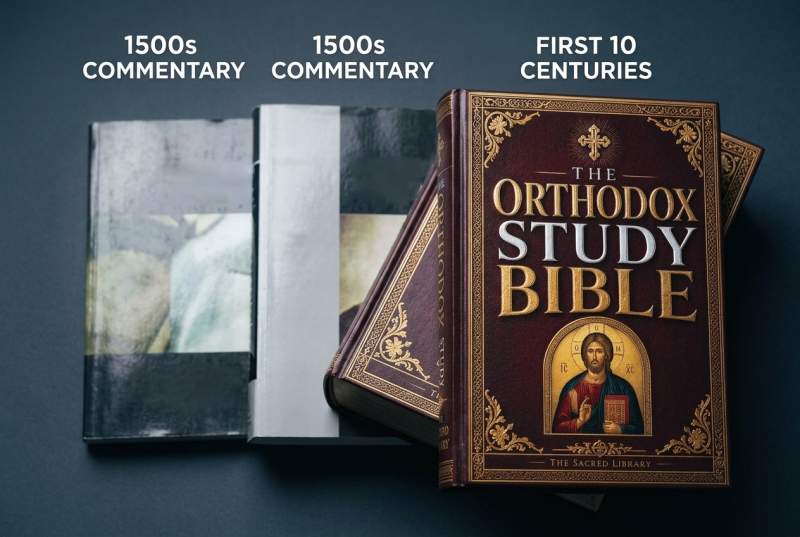
Before you spend sixty dollars on another study Bible, here is what the product description won't tell you. The ESV Study Bible — the bestselling study Bible in evangelical America — is a masterwork of Reformed theology. Its footnotes are written from within a tradition that crystallized in 16th-century Europe. That tradition is rigorous. It is internally consistent. And it applies a specific lens — Calvin, Luther, Zwingli's intellectual descendants — to every book of Scripture, including books of the Bible that were written fifteen centuries before the Reformation existed.
The NIV Study Bible and NASB equivalents operate within the same basic paradigm. Ecumenical enough to avoid denominational flags, academic enough to signal credibility, cautious enough to never quite tell you what to believe about the hard passages. The Ignatius Catholic Study Bible is closer to what you're looking for — patristic and creedal, not Reformation-filtered. But it is authored from within Roman Catholic systematic theology, which means papal authority, the filioque, and post-schism doctrinal developments are baked into the commentary.
The notes draw from Patristic sources which pre-suppose Faith rather than the skeptical 'scholarship' that readers are usually subjected to. Reading this Bible is a truly prayerful experience.— EChris, Christianbook verified review — 29 people found this helpful
Here is the specific risk: if you buy one of these study Bibles and spend a year reading through it, you will absorb its theological assumptions through the footnotes whether you intend to or not. The commentary is the product. The text is the carrier. The tradition doing the interpreting shapes what you think the text means. That is not a conspiracy. That is how study Bibles work. It was always the design. The question is whether the tradition embedded in the notes is the one you want inside your reading of Scripture.
A 5th-Century Bishop Wrote Better Footnotes Than Your Study Bible

The Church Fathers — Chrysostom, Augustine, Athanasius, Basil the Great, Gregory of Nyssa — spent their entire lives inside Scripture. Not studying it from a distance. Living inside it, preaching it weekly, defending it against heresies in real-time, dying for specific claims about what specific texts meant. Their commentary was written by people for whom the question "is this true?" was not an intellectual exercise. It was the organizing principle of an entire civilization.
John Chrysostom's homilies on Matthew were not written for an academic journal. They were delivered to a congregation in Antioch in the late 4th century. The questions he answered are the same ones you're sitting with right now — what does this passage mean, what does it ask of me, how do I live inside it? That is what patristic commentary is. Not a study note written with professional scholarly detachment in a seminary office in the 1990s. Not a footnote that says "some scholars believe." A bishop, in the room with his people, saying: this is what this means, this is what it demands, this is the faith that was delivered to us.
Source: The Orthodox Study Bible, St. Athanasius Academy of Orthodox Theology editorial team — commentary drawn from Christian writers and teachers of the first ten centuries.Before you evaluate any study Bible, there is one question worth asking before you open the features list: Are the footnotes written from inside the faith, or from a respectful academic distance from it? One reviewer named it exactly — she had been searching for notes that "pre-suppose Faith rather than the skeptical 'scholarship' that readers are usually subjected to." Pre-suppose Faith. That phrase is worth sitting with. Because the inverse — footnotes that pre-suppose doubt — is what you've been reading. And you've been feeling it without having the language for it.
If you want to see what commentary written from inside the faith looks like, you can verify it for yourself before you spend a dollar.
What Patristic Commentary Looks Like in Practice — And How to Verify It Before You Buy

The Orthodox Study Bible's footnotes are drawn from the Christian writers and teachers of the first ten centuries of the Church. Not the 16th century. Not the 19th century. The first ten. The Old Testament is freshly translated from the Septuagint — the Greek text the Apostles quoted — and the full Deuterocanon is included: Tobit, Judith, Wisdom, Sirach, and Maccabees I through III. Before you decide whether this is the right study Bible for you, here are three things you can verify right now — before purchasing anything.
The Orthodox Study Bible — Complete Spiritual Bundle adds what the physical book alone doesn't have: three digital companion guides — on the Church Fathers, Orthodox spiritual practice, and the early Church — plus a full audiobook for study anywhere. And the 100% money-back guarantee means you can verify the commentary quality yourself — read thirty pages of patristic footnotes and decide whether the notes pre-suppose faith or undermine it — and if they don't deliver, you pay nothing.
Three Things to Verify Before You Buy Any Study Bible
Check Who Wrote the Notes
Open the introduction of any study Bible you're considering. Look for named commentary sources. If they're 20th-century Reformed or evangelical theologians, the lens is post-Reformation. The Orthodox Study Bible draws explicitly from the patristic tradition — the first ten centuries.
Check the Old Testament Source Text
Ask: is this Bible's Old Testament translated from the Septuagint or from the medieval Hebrew Masoretic text? Most Protestant study Bibles use the Masoretic. The Orthodox Study Bible uses the Septuagint — the text the Apostles actually quoted.
Check Whether the Deuterocanon Is Present
Tobit. Judith. Wisdom. Sirach. First, Second, and Third Maccabees. If those books are not in the Old Testament you're considering, it does not contain the full canon the early Church used.
What Readers Who Researched This Before Buying Found

You are not the first person to come to this question through careful research. Here is what people who went through the same evaluation process discovered when they got the book. The 4.8-star average holds across thousands of global ratings — and 90% of reviewers on Christianbook recommend it. The pattern in the reviews is consistent: readers who had spent time with ESV or NIV study Bibles describe the shift in the patristic commentary as qualitative, not incremental. Not "slightly better notes" — a fundamentally different relationship to the text.
Finally, we can now read and understand the Holy Scriptures of our Christian faith with the same eyes as the earliest Christians, before all these divisions and denominational views. Truly, this is a predenominational work that every Christian must have and use — it is wrongly called the 'Orthodox' study Bible, as it should be called the Ancient or Original Study Bible.— Joseph the Betrothed, Christianbook verified review — 23 people found this helpful
Samar, another verified Christianbook reviewer, put the practical consequence plainly: "I have made this my choice of gift to everyone I know since I found it." If you want to verify whether the notes deliver what this article described, the 100% money-back guarantee means you can do that without any purchase risk.
"But I'm Not Orthodox — Am I Even Allowed to Buy This?"

This is the most common question people ask before purchasing, and the answer from readers who've already worked through it is worth hearing directly. Joseph the Betrothed, who left one of the most-cited verified reviews, addressed this head-on: "It is wrongly called the 'Orthodox' study Bible, as it should be called the Ancient or Original Study Bible." He described it as "a predenominational work that every Christian must have and use."
The commentary in this Bible was written in the first ten centuries of Christianity — before the Great Schism, before the Reformation, before any of the denominational labels that exist today. It belongs to the whole Church. It was written for anyone who wants to encounter Scripture as the earliest Christians received it, regardless of where they are in their journey. You don't need to be Orthodox to read it. You need to want the older voice.
The guarantee removes the remaining risk entirely. You have time to open the volume, read thirty pages of patristic footnotes, and decide — before you've committed to anything — whether the notes pre-suppose faith the way this article described.