The Seven Books Most American Christians Have Never Read — And Why They Were Removed
The Old Testament the Apostles used contained books that quietly disappeared from Protestant Bibles five centuries ago. Here's what was lost, who decided, and what scholars are saying now.


There is a detail about the Bible most American Christians carry that almost no one mentions in Sunday school, in seminary brochures, or in the opening pages of any popular study edition sold at Christian bookstores today. It is not a matter of translation preference — which Greek manuscript to favor, whether "young woman" or "virgin" is the better rendering of a particular Hebrew word. It is something more structural than that. It is about what is actually in the book.
The Old Testament that appears in the majority of Protestant Bibles sold in the United States contains 39 books. The Old Testament that was in use among Jews in the Greek-speaking world of the first century — the text most commonly quoted in the New Testament, the text read aloud in the early churches, the text carried by missionaries across the Roman Empire — contained more. Significantly more. And the books that were present in that earlier collection but are absent from the edition most American Christians hold in their hands today were not lost to history. They were removed. The removal happened at a specific moment in time, for specific reasons, by specific people. Most of the people reading a Bible right now have never been told any of this.
That story — of what was in the original collection, why it changed, and what those additional books actually contain — turns out to be one of the more quietly consequential chapters in the history of Western Christianity. It is also, depending on where you look, entirely recoverable.
The Version That Came First

The Greek version of the Hebrew Scriptures, known as the Septuagint, was the dominant Old Testament of the early Christian world. Compiled in Alexandria beginning around the third century BC, it was used extensively by Greek-speaking Jews before the time of Jesus and was the Scripture that the New Testament writers knew intimately. A majority of the Old Testament quotations that appear in the New Testament — passages cited by Paul, by the author of Hebrews, by Peter in his letters — are drawn from this Greek text, not from the Hebrew text that would later become the basis for the Protestant Old Testament.
The Septuagint included books and portions of books that were standard reading in the early Church: Tobit, a wisdom story about a righteous man and his family navigating exile; Judith, a narrative about a widow who saves her people; the Wisdom of Solomon, a meditation on righteousness and human mortality; Sirach, a comprehensive guide to ethical and spiritual life attributed to a Jerusalem sage; and the Books of Maccabees, which document the Jewish revolt against Hellenistic oppression in the second century BC. First and Second Maccabees, in particular, provide the historical background for the festival of Hanukkah and contain some of the most explicit early statements about resurrection and prayer for the dead found anywhere in the ancient Jewish corpus.
These texts were not marginal curiosities preserved in a footnote somewhere. They were read, quoted, and built upon by the early Church Fathers — the theologians and bishops of the first through fifth centuries who defined the shape of Christian doctrine. They appear in the writings of Clement of Alexandria, Origen, Ambrose, Augustine, and John Chrysostom. Augustine's City of God draws directly from the Wisdom of Solomon. The theology of martyrdom that animated early Christian witness was shaped in part by the stories in Maccabees. Origen's reflections on prayer for the dead connect explicitly to Second Maccabees 12.
This was not a peripheral text. It was the Scripture of the early Church — the collection Paul carried, the collection the Fathers preached from, the collection that shaped every major doctrinal formulation of the first five Christian centuries.
The Moment Everything Changed

The books did not disappear by accident. In the sixteenth century, the Protestant Reformers — Martin Luther chief among them — made a deliberate decision about the boundaries of the Old Testament. Luther looked to the Hebrew canon used by Jewish rabbis in the centuries after the destruction of the Temple, a collection that did not include the additional books of the Septuagint. He placed those books in a separate section of his German Bible, labeling them "Apocrypha" — useful for reading, he noted, but not to be used as the basis for doctrine. Within a generation, most Protestant traditions had removed them from the canon entirely. By the time the British and Foreign Bible Society stopped printing them in the 1820s, they had vanished from the Bibles that most English-speaking Protestants would carry for the next two centuries.
The Eastern Orthodox Church — one of the three major historic branches of Christianity alongside Catholicism and Protestantism, tracing its institutional continuity to the earliest ecumenical councils — never accepted this revision. The Septuagint remained its Old Testament. The additional books remained canonical. Catholic Bibles retained most of them as well, under the term "deuterocanonical" — a word that means simply "belonging to the second stage of canon formation," not "less authoritative."
What this means in practical terms is that the Old Testament in most Protestant Bibles sold in America today reflects a canon that was redefined in the 1500s, not the canon that was in use when Paul was writing his letters or when Irenaeus was compiling his arguments against Gnosticism.
"The Orthodox Study Bible is great because it has a vibrant translation of the full Orthodox canon including books that Protestants don't have — like Judith, Tobit, and I, II, and III Maccabees."— Goodreads verified reviewer
The question — which is worth sitting with — is not whether the Reformers were wrong to make this choice. Thoughtful historians have argued both sides of that question for five centuries. The question is simply whether most people who read a Bible today know that the choice was made at all.
What Scholars Are Saying Now

In recent years, a small but measurable shift has been underway in American Christianity. According to data published by the Orthodox Studies Institute in 2024, the number of converts entering the Orthodox Church in America has risen significantly — driven substantially by men under 40 coming from Protestant and evangelical backgrounds. Independent coverage in The New York Times, The Wall Street Journal, and Religion Unplugged has documented the trend from multiple angles. Clergy interviewed across these outlets point to a common pattern: people who grew up in Protestant traditions and began asking deeper questions about the ancient faith — what the early Church actually believed, what Scripture it actually read, what the Fathers actually taught — found themselves drawn to a tradition that never altered those foundations.
The canon question is not the only thing driving that movement. But it is among the first things that surprises people when they begin to look. A reader who picks up a Greek New Testament and starts tracing Paul's Old Testament quotations to their source finds, repeatedly, that Paul is quoting from the Septuagint — from a text whose full version includes Tobit, Judith, Wisdom, Sirach, and the Maccabees. The book that is being quoted was already in the library. It simply was not in the edition the reader had been given.
Scholars who study the early Church have been saying for decades that the Protestant canon question deserves more attention than it receives in ordinary parish life. What has changed recently is that ordinary readers — not seminarians, not academic theologians, but people asking questions on their own time — are beginning to find their way to the same conclusion. They are looking for an edition of the Bible that contains what the Apostles actually read. And until fairly recently, that edition was not easy to find in a single English volume.
This is what biblical historians and early-Church scholars have been documenting for decades. See what we found →
Since this article was first published, our editorial team received hundreds of messages from readers who wanted to know where to find an English Bible containing the full Septuagint canon with early-Church commentary. We spent several weeks reviewing the editions available. One stood out — not only for its completeness but for the depth of its scholarly and patristic apparatus, and for the way it packages everything a reader needs in one place.
The Edition That Passed Review
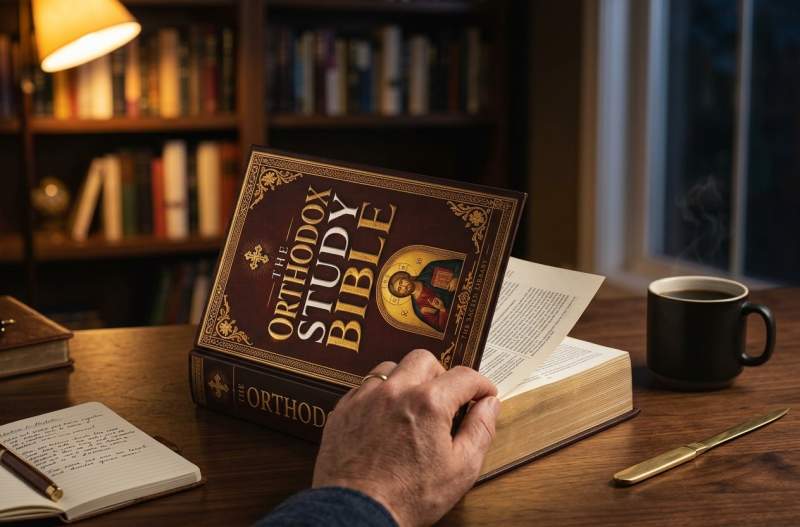
What makes the Orthodox Study Bible distinctive is not one feature but the combination of features that exist nowhere else in a single English volume. Its Old Testament is drawn from the St. Athanasius Academy Septuagint — a fresh English translation of the Greek text that the early Church read, complete with the full Deuterocanon: Tobit, Judith, the Wisdom of Solomon, Sirach, First, Second, and Third Maccabees, and the additional portions of Daniel and Esther absent from Protestant editions. Its New Testament uses the New King James Version translated from the Byzantine text tradition. Running alongside both is a patristic commentary apparatus drawn from the Christian writers and teachers of the first ten centuries — the era before the Great Schism, before the Reformation, before the fractures that divided Western Christianity into its current denominations.
The volume carries endorsements from Metropolitan Maximos of the Greek Orthodox Archdiocese of America, Metropolitan Phillip of the Antiochian Orthodox Christian Archdiocese, and Metropolitan Theodosius of the Orthodox Church in America — three separate jurisdictions — which signals a level of cross-traditional authority unusual in Bible publishing. Beyond Scripture and commentary, the edition includes liturgical lectionary readings, morning and evening Orthodox prayers, pre-communion prayers, book introductions, a subject index, and full-color icons and maps. It is, in the assessment of the readers who have spent the most time with it, the closest thing available in English to reading Scripture the way the early Church read it.
The Sacred Library Complete Spiritual Bundle pairs the Orthodox Study Bible with three digital companion volumes — The Church Fathers Explained, Orthodox Spiritual Practices Guide, and Understanding the Early Church — along with a full audiobook version for daily listening. The bundle is designed as an onboarding system: not just a Bible to read on Sunday, but a complete set of tools for understanding what the early Church believed, how it prayed, and how to enter that world as a reader coming from outside it.

- ✓Full Septuagint Canon — Includes all seven books absent from Protestant editions, with patristic commentary from the first ten centuries of the Church
- ✓3 Digital Companion Guides — The Church Fathers Explained, Orthodox Spiritual Practices Guide, and Understanding the Early Church, delivered instantly
- ✓Complete Audiobook — Full Bible audio version for daily listening, driving, and spiritual immersion
What Readers Are Discovering

The reviews that accumulate around this edition over its eighteen-year publishing life describe something consistent: a sense of arrival. Not the arrival of someone who has solved a puzzle, but of someone who has found the fuller version of something they were already reading.
"Finally, we can now read and understand the Holy Scriptures of our Christian faith with the same eyes as the earliest Christians, before all these divisions and denominational views. Truly, this is a predenominational work that every Christian must have and use — it is wrongly called the 'Orthodox' study Bible, as it should be called the Ancient or Original Study Bible."— Joseph the Betrothed, verified reviewer (23 people found this helpful)
Readers who arrive from Protestant traditions consistently note that the commentary feels categorically different from what they encountered in other study editions — not more doctrinally assertive in a sectarian sense, but differently grounded. One verified reviewer wrote that "the notes draw from Patristic sources which pre-suppose Faith rather than the skeptical 'scholarship' that readers are usually subjected to." Another described the experience of reading it as "truly prayerful." These are not the kinds of words people use about study tools. They are the kinds of words people use about something that changed how they see.
Hundreds of readers found what they were looking for. See the edition →
The Question Every New Reader Has

The most common hesitation among readers who encounter the Orthodox Study Bible for the first time is a version of the same question: Am I the right person to read this? The word "Orthodox" in the title reads, to many Protestant or non-denominationally churched readers, as a denominational restriction — a signal that this is someone else's book, for someone else's tradition.
It is not. The editorial apparatus was designed specifically to make the early Church's reading of Scripture accessible to any Christian who wants to encounter it. As one of the most-cited reviewers wrote: it "should be called the Ancient or Original Study Bible" — because the commentary tradition it draws from predates every Protestant denomination, every Catholic reformation, and every schism that divided the Church. The Church Fathers it quotes wrote before these divisions existed.
If the question is whether a reader needs to be Orthodox, converting to Orthodoxy, or planning any denominational change to benefit from this edition — the answer is plainly no. If the question is whether a reader who is genuinely curious about what the Bible looked like before the Reformation reshaped it can read this edition without qualification — the answer is yes. The Sacred Library bundle includes a 100% money-back guarantee, no questions asked. The risk of finding out is zero.