You've Been Trying to Feed Your Family Better Flour for Years. The System Keeps Letting You Down.
For home bakers, health-conscious moms, sourdough lovers, and anyone who's ever stood in the grocery aisle wondering if there's a better way — here's what nobody in the food industry wants you to figure out.
You're the person in your house who reads the label. You switched to organic flour because you believed it was better. You paid more. You made the swap. And somewhere in the back of your mind, you told yourself: at least I know what's going into our food.
Then someone told you the truth about commercial flour — all of it, including the organic bag sitting in your pantry right now — and you couldn't unknow it. A registered dietitian described the moment she learned about fresh-milled flour this way: "I cried! Real, unexpected tears… even after years of working as a dietitian, I had been missing something so foundational." That quote probably hits harder than it should. Because you felt it too, didn't you?
Here's the tension nobody talks about honestly: you want to do better. You've tried to do better. And yet the solutions available to you have either been too expensive, too complicated, or quietly worse than advertised. The premium grain mills that the serious baking community actually recommends — MockMill, NutriMill, KoMo — start at $300 and run past $800. The cheap Amazon grinders break within weeks. The KitchenAid attachment risks burning out a $400 mixer. And the "whole wheat" or "organic" flour at the store? It sat in a warehouse for months after milling, losing the very nutrients you were paying a premium to get.
The problem isn't that you haven't tried hard enough. The problem is that every solution in this space has been designed either for people with $500 to spend on a kitchen appliance — or for people who don't care what's actually in their flour. You've been stuck in the middle. That's exactly the gap the FreshGrain Mill was built for.

The Moment You Realized "Better" Flour Was Still a Lie
There's a specific kind of frustration that builds up slowly.
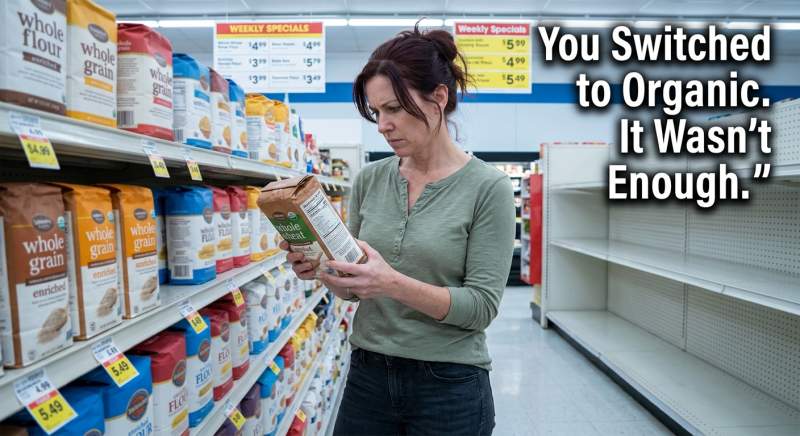
It starts the first time you pay $4.99 for a bag of organic whole wheat flour because you've decided your family deserves better. It grows when you learn that "enriched" flour means the government requires manufacturers to add back a handful of synthetic vitamins to replace the dozens of natural ones that were stripped out during industrial processing. It becomes something closer to betrayal when you discover that potassium bromate — a flour-treatment chemical banned in the European Union, Canada, the United Kingdom, Brazil, and China — is still completely legal in US flour production.
You weren't paranoid. You weren't a conspiracy theorist. You were right to be suspicious.
Harvard T.H. Chan School of Public Health has confirmed that industrial milling removes more than 50% of B vitamins, approximately 90% of vitamin E, and nearly all fiber from wheat grain. The federal government's response — mandatory synthetic enrichment under 21 CFR 137.165 — replaces only a fraction of what was lost, using lab-manufactured vitamins. That's not a fringe claim from a wellness blog. That's peer-reviewed nutrition science and federal regulatory code.
The community of home millers has a name for what comes out of that industrial process: "dead flour." And once you hear that phrase, it's impossible to stop applying it. One blogger put it simply: "I now call fresh-milled flour 'alive' and store-bought flour 'dead.' And it's really true." That metaphor isn't marketing language — it emerged organically from people who made the switch and couldn't find a less accurate word for what they'd been eating.
What makes this frustrating rather than just disappointing is the guilt that comes with it. You've been feeding your family something you now recognize as nutritionally compromised — and you were trying. You were paying extra for organic. You were reading the label. The system looked you in the eye and told you that was enough. It wasn't.
That guilt is real, and it's worth naming, because it's the reason this problem doesn't stay abstract. It's personal. Every loaf baked with store flour after you learn the truth carries a small weight. And the anger underneath the guilt — at the food industry, at a system that profits from your trust — is legitimate.
Everything You've Already Tried — And Why None of It Worked

If you're the kind of person who researches before she buys, you've probably already tried at least one of the following. And if you've tried any of them, you already know the feeling of almost solving this problem — followed by the sinking realization that you didn't.
The premium flour gambit. You started buying organic. Maybe you upgraded to "stone-ground whole wheat." You paid $4–$5 per pound and told yourself you'd solved the nutrition problem. Then you learned that organic certification has nothing to do with when the flour was milled — or how long it sat in a warehouse afterward. Oxidation doesn't check the organic label before it starts degrading the vitamins and fiber in your bag. The nutrient loss Harvard documented happens during refining. The additional time-based degradation happens in storage and on the shelf. You paid a premium for a product that was still compromised before it reached you. As one miller put it: "I was paying more for nothing."
The KitchenAid attachment. This one is particularly painful because it feels so logical. You already own a great mixer. There's an official grain mill attachment. The math seems to work — $100–$150 for an accessory you attach to a tool you love. Except the baking community has known for years that this attachment is a trap. A professional KitchenAid repair technician has explicitly stated: "Mr. Mixer advises against using a grain mill attachment as it is hard on the mixer." The attachment overheats your motor, produces coarse and inconsistent flour, is limited to ten cups per batch, and puts a $300–$400 appliance at genuine risk of damage. You might get flour. You might also get a repair bill.
The cheap Amazon grinder. This is the most common first attempt, and the most common first failure. A $40–$80 blade grinder from an unfamiliar brand. It looks like a mill. The listing says it grinds grain. You order it. And then, as one verified customer described: "I had bought a cheapish ($80) on Amazon and it broke after a month." The home-milling community is not sympathetic to this experience — they predicted it. Their consensus is stark: "All the mills costing less than $400 were more like toys."
The blender and food processor detour. Before you spend money on anything, you try what you have. The blender overheats on the second batch. The food processor leaves the texture closer to coarse meal than flour. The cleanup takes longer than the grinding. You get something that technically qualifies as "ground grain" but bakes like it too — dense, gritty, unpredictable. You abandon this approach after two or three experiments.
The premium mill research spiral. Here's where most serious home bakers end up: staring at $300–$890 grain mills, reading comparison charts, haunting the baking forums, watching YouTube videos, and eventually putting the tab to sleep because the numbers don't justify a first purchase. As one Fresh Loaf forum member captured it perfectly: "I am racking my brains out trying to choose one as there are upsides, downsides to every single one of them or they are $1000!" This isn't weakness. This is rational behavior in a market where the entry price is artificially high and the low-cost options have a documented reputation for failure.
The pattern across all of these experiences is the same: you found the edges of a market that hasn't made room for someone like you. Too expensive on one end. Too unreliable on the other. And stuck in the middle, paying premium prices for flour that still isn't what you need it to be.
Here's What Actually Changes When You Grind Your Own Grain

The principle behind fresh-milling flour at home is straightforward — and once you understand it, the reason every other solution has failed becomes obvious.
Commercial flour is not just grain that was ground and packaged. It's grain that was industrially refined — meaning the bran and germ were deliberately stripped away, the grain was processed at industrial scale, synthetic vitamins were added back to meet federal enrichment standards, and then it sat. In a silo. In a warehouse. In a distribution center. On a store shelf. Months passed. The nutrients that survived the refining process continued to oxidize. You bought it at the end of that chain.
Fresh milling breaks that chain entirely. When you grind whole grain kernels into flour at home, you are working with the complete, intact grain — bran, germ, and endosperm all present. Harvard's data is clear on what this means: the nutrients that industrial refining strips away (more than 50% of B vitamins, approximately 90% of vitamin E, nearly all dietary fiber) are still there in the whole kernel. You grind it. You use it. The distance between "intact grain" and "fresh flour in your bowl" is measured in minutes, not months.
The FreshGrain Mill operates at 25,000 RPM inside a 300g stainless steel chamber. You load your grain — wheat berries, oats, rice, quinoa, spelt, whatever you choose — press the button, and fresh flour comes out the other side in about 60 seconds per batch. There is no complicated setup. There is no technique to master before your first use. One button. One minute. Fresh flour.
The turning point for most home millers isn't the first batch of flour. It's the first loaf of bread. "This is what bread is supposed to taste like" is the most common thing people say. Not because the recipe changed. Because the ingredient changed. The flour that comes out of a home mill has a faint golden color, a subtly sweet smell, and a flavor that store flour — stripped, aged, and artificially enriched — simply cannot replicate.
The mechanism is not magic. It's the removal of every step that happens between the grain and your kitchen. No industrial refining. No synthetic enrichment. No warehouse months. No shelf oxidation. You control the grain. You control the grind. You know exactly what went into the flour because you put it there.
That control — over the most basic ingredient in your pantry — is what the food industry has held for a hundred years. The FreshGrain Mill puts it back in your hands.
What Changes in Your Kitchen — Starting With the First Batch
Let's talk about what actually happens when the FreshGrain Mill becomes part of your weekly routine. Not the nutritional theory. The lived experience.
You start with whole grain kernels. Wheat berries are the most common starting point — you can find organic hard white wheat berries for $0.60–$1.50 per pound, compared to $1.50–$3.00 per pound for organic flour. They store for up to 25–30 years in sealed containers. Your pantry becomes a grain pantry. You stop thinking about running out of flour the way you stop thinking about running out of something you always have on hand.
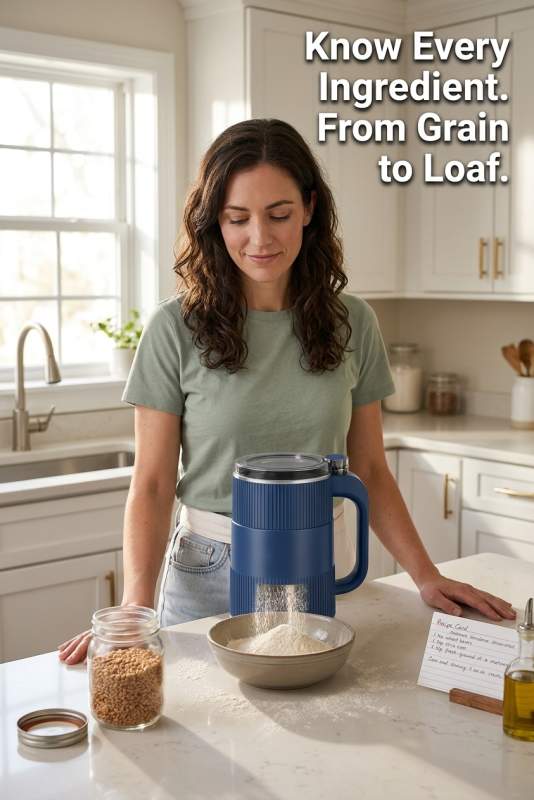
You load the 300g stainless steel milling chamber — roughly enough for one to two loaves of bread, depending on your recipe. Press the button. In about 60 seconds, you have freshly ground flour sitting in the chamber, slightly warm, with that faint sweet-wheat smell that store flour doesn't have. It looks different too. Not the stark white of bleached all-purpose. A soft, natural cream-to-golden color that tells you the whole grain — bran, germ, everything — came through intact.
Then the baking. This is where the difference stops being theoretical.
If you bake sourdough, you will notice it in your crumb first. Fresh-milled flour has more enzymatic activity than aged store flour — this is well-documented in the baking community — and your starter interacts with it differently. The loaves that the sourdough community describes as "game changers" and "took my bread to another level" are loaves made with freshly milled grain. The crust gets better. The crumb opens up. The flavor deepens in ways that whole wheat store flour simply cannot produce.
If you bake for a family that has historically rejected whole wheat — the "yucky" whole-grain bread problem is real, documented, and nearly universal — fresh-milled flour changes the equation. The bitter, dense, almost cardboard quality of commercially produced whole wheat bread comes largely from the flour's age and the loss of the germ's natural oils. Fresh flour doesn't have that problem. Families who have refused whole grain for years eat fresh-milled bread without complaint. Some of them ask for seconds.
If you're a preparedness-minded household, the picture shifts again. Wheat berries are among the most shelf-stable foods known. Properly sealed, they store for 25–30 years. You don't have to rotate them. You don't have to worry about moths or moisture if they're sealed correctly. And when you need flour — for any reason, in any circumstances — you have a countertop mill and a year's supply of whole grain and you are not dependent on a supply chain. As one customer wrote: "There were times I had no money for food. My friend and this mill saved my life."
For families managing gluten sensitivity, the control dimension becomes medical rather than philosophical. One blogger described it: "Out of the 6 people in my immediate family, 4 of us have varying levels of gluten intolerance. All 4 of us can eat as much of these breads, muffins and rolls from the grains milled at home and we have zero issues." The 304 stainless steel milling chamber contains no shared equipment, no prior cross-contamination history. You control every grain that goes into your flour.
The FreshGrain Mill also grinds beyond wheat. Oats, rice, quinoa, spelt, rye, buckwheat — the stainless steel chamber handles all of them. Your gluten-free baking, your homemade oat flour, your fresh rice flour for delicate pastries — one mill, one button, one minute. The safety lid lock means you can load, press the button, and step away without worrying about small hands getting curious.
The Evidence You Should Have Before You Spend a Dollar

Let's put the claims on the table and run them against real data.
The nutrition claim: Harvard T.H. Chan School of Public Health confirms that industrial milling removes more than 50% of B vitamins, approximately 90% of vitamin E, and nearly all dietary fiber from wheat grain. The federal enrichment mandate under 21 CFR 137.165 adds back a limited set of synthetic vitamins — thiamine, riboflavin, niacin, folic acid, and iron — and does not restore vitamin E, does not restore the full B-vitamin complex, and does not restore the fiber. This is peer-reviewed science and federal regulatory code. It is not contested.
The chemical claim: Potassium bromate — used as a dough conditioner in commercial flour production — is classified as a possible human carcinogen (IARC Group 2B) and has been banned in the European Union, Canada, the United Kingdom, Brazil, and China. It remains legal in the United States. This is verifiable from regulatory databases of every country named. When you mill your own grain from whole wheat berries, no potassium bromate has ever been added to the grain at any point in the supply chain.
The savings math — run honestly: Organic wheat berries cost $0.60–$1.50 per pound. Organic all-purpose flour costs $1.50–$3.00 per pound. The real savings are 30–50% per pound of flour produced. At two loaves of bread per week, using approximately 1.5 lbs of flour per loaf, the FreshGrain Mill's $79.99 price pays for itself in 8–12 weeks. Everything after that is savings.
The comparison that matters most: The KitchenAid grain mill attachment costs $100–$150. A professional KitchenAid repair technician has publicly stated the attachment is hard on the mixer — meaning a $100–$150 attachment puts a $300–$400 mixer at documented risk of motor damage. The FreshGrain Mill is a dedicated grain mill at $79.99 — less than the attachment, zero risk to your existing equipment.
What the community actually says about sub-$100 mills: The concern is real, and we're not going to pretend otherwise. The Good Bad and Ugly Grain Mill Comparisons site — one of the most referenced independent grain mill review sources — has stated that mills under $400 feel like toys. That concern was earned by a generation of cheap Amazon blade grinders. The response to that concern isn't a marketing claim. It's our 30-day money-back guarantee, full stop. If the FreshGrain Mill doesn't produce real, usable flour from your grain — if it feels like a toy, if it underperforms in any way — you return it within 30 days for a complete refund. No argument. No restocking fee.
The competitor's claims versus ours: You may have encountered another grain mill advertised at a similar price point with a "4.8/5 from 2,847+ customers" rating. That rating does not exist on Trustpilot, Google Reviews, the Better Business Bureau, or Amazon. Zero external verification exists for that social proof claim. We are not asking you to take our word over theirs. We're asking you to verify both.
Wheat berries are real. Harvard's data is real. The potassium bromate ban is real. The honest savings math is real. The 30-day money-back guarantee is real. That's the evidence basis for this purchase.
"But Isn't a $79.99 Mill Just Another Toy That's Going to Break?"

This is the right question. Ask it.
The home-milling community has been burned before. The documented history of sub-$100 grain mills is not encouraging: cheap Amazon blade grinders that break within weeks, inconsistent grind sizes, motors that overheat on the second batch, plastic components that crack. The community's verdict — "all the mills costing less than $400 were more like toys" — came from experience, not snobbery. If you've been researching grain mills for more than twenty minutes, you've read some version of that warning.
We're not going to argue with it through marketing claims. We're going to handle it with the one answer that actually matters: you risk nothing.
The FreshGrain Mill comes with a 30-day money-back guarantee. Not a partial refund. Not store credit. Not "minus shipping and handling." A complete refund if you're not satisfied — for any reason. You have thirty days to mill grain, bake bread, test every feature, and decide whether this is a product that earns a place in your kitchen. If it doesn't, you tell us, you get your money back, and we part ways. That guarantee exists because we know the objection is legitimate. A product that couldn't back it up wouldn't offer it.
Here's also what's worth understanding about the price: the FreshGrain Mill is not positioned as a lifetime investment. It's positioned as an honest entry point. The $300–$890 stone burr mills that the serious milling community recommends are extraordinary machines. They are also asking you to commit $300–$890 to a habit you may not yet have. The FreshGrain Mill asks you to spend $79.99 to find out if milling flour at home is something you want to make part of your life. Many people try it and never look back. Some try it and decide to upgrade to a premium stone burr mill later — having confirmed that the habit is worth the investment. Either path starts at $79.99 and a month of honest testing.
We're also including a Fresh-Milled Baking Guide with every order. This matters more than it sounds.
The most commonly documented frustration in home milling isn't the mill — it's the first few loaves. As Twisted Ash Farm put it: "I wanted to jump right in and try all kinds of recipes! Only to wind up feeling frustrated with breads that did not rise and hard, flat cookies. I almost gave up!" Fresh-milled flour behaves differently from store flour. It absorbs more water. It has more enzymatic activity. It needs different handling. "Everything I knew about baking with white flour went out the window," wrote one experienced baker.
The baking community knows this. Brands selling grain mills almost universally hide it — because the learning curve is bad for conversion rates. We're telling you upfront: your first loaf may not be perfect. The guide tells you why, what to adjust, and what the common mistakes are before you make them. Because a customer who bakes great bread with their FreshGrain Mill is not going to return it.
You deserve the honest version of this product, which is: the mill works, the flour is real, the savings are real, the nutrition difference is real — and you will probably need a week of adjustment before you're baking the loaves that make you say "I'm never going back."
That's the product. You have 30 days. Try it.
What Home Bakers Are Saying
"I'll never forget the day I discovered the truth about fresh milled flour. I cried! Real, unexpected tears… even after years of working as a dietitian, I had been missing something so foundational."
— Registered Dietitian & Home Baker
"I now call fresh-milled flour 'alive' and store-bought flour 'dead.' And it's really true. There is no going back to grocery store flour after you experience this."
— Sourdough Baker, Pacific Northwest
"Out of 6 people in my family, 4 of us have gluten intolerance. All 4 of us can eat as much bread, muffins and rolls from grains milled at home — zero issues."
— Home Homesteader, Mountain West
You've Been Waiting for a Way to Do This Right. Here It Is.
The "dead flour" problem is real. The science behind it is Harvard-verified and federally documented. The frustration of trying to solve it — and watching every solution fail — is something thousands of home bakers have felt before you. You're not late to this. You're just finally finding the version that works.
Here's what you get with every FreshGrain Mill order:
- ✅ Fresh flour in under 60 seconds — from whole grain kernels to fresh-ground flour, one button, no technique required
- ✅ Significantly more nutrition — you're working with the complete, intact grain before oxidation and industrial refining enter the equation — Harvard confirms what's at stake
- ✅ Real savings — organic wheat berries at $0.60–$1.50/lb versus organic flour at $1.50–$3.00/lb — the mill pays for itself in 8–12 weeks at normal baking frequency
- ✅ 30-day money-back guarantee — complete refund, no questions, if this isn't the right product for your kitchen
- ✅ Fresh-Milled Baking Guide included — hydration charts, recipe conversions, and the exact adjustments that turn the learning curve into your first great loaf
The FreshGrain Mill is not asking you to commit $400 to a lifestyle change you haven't tried yet. It's asking you to spend $79.99 — with a full month to decide if you want to keep it.
The families who are already milling their own grain describe the moment they tasted the difference as a turning point. One baker called it a "game changer." Another said she "took her bread to another level." A registered dietitian, after decades of nutrition work, said she cried when she realized what she'd been missing.
You're one batch away from understanding what they mean.
Multi-pack options available: 2 mills for $119.99 — 3 mills for $149.99. Free shipping on all orders. 30-day money-back guarantee. Stock is limited — orders ship within 1–2 business days.