You Want to Understand Theology. Every Path to Get There Is Designed to Make You Quit.
The 1,600-page textbooks. The $500-per-class seminaries. The devotionals that never go deep enough. There's a reason serious Christians keep starting over — and it has nothing to do with faith, intelligence, or discipline.

You've tried this before.
Maybe it was a New Year's resolution. Maybe it was after a sermon that cracked something open — a sudden, almost physical desire to actually understand the doctrines you've been hearing your whole life. The Trinity. Election. Sanctification. The nature of God. Not greeting-card-deep. Foundation-deep.
So you bought the book everyone recommended. Or you looked into seminary classes. Or you downloaded an app, or started a podcast series, or signed up for a Bible-in-a-Year plan that promised theological depth along the way.
And for a few weeks — maybe even a month — you felt like you were getting somewhere. Then the pages got denser. The schedule got harder. The concepts started stacking up faster than you could absorb them. And one quiet evening, you set the whole thing aside and told yourself you'd come back to it later.
You didn't come back.
Not because you lacked discipline. Not because theology "isn't for you." But because every resource available to you was built for someone else — a seminarian, an academic, a pastor in training — and nobody bothered to tell you that before you spent the money.
The gap between wanting theological depth and having a realistic path to get it has been wide open for decades. This is the story of why that gap exists, what's been keeping it open, and the system that finally closes it.
The Textbook That Became a Shelf Decoration

Here's a fact that should bother you.
The most recommended systematic theology textbook in the English-speaking world — the book pastors, professors, and every "serious Christian reading list" on the internet has been pointing people toward for three decades — costs $59.99.
For that $59.99, you get one thing: 1,600 pages of dense, academic prose.
No audiobook. No study companion. No discussion questions. No memory aids. No companion materials of any kind. Just text — collegiate-level text, written for a seminary classroom, bound between two covers, and shipped to your door with an implicit promise that if you're serious enough about your faith, you'll figure it out.
Most people don't figure it out.
One verified Amazon reviewer wrote: "Be warned… it is more of a collegiate level book and can be really hard to follow."
Another: "I am not a seminary student. I sometimes got lost in the philosophical discussions."
These aren't people who gave up easily. These are Christians who spent $59.99, cleared time in their schedules, opened the book with real intention — and walked away feeling like the problem was them.
It wasn't them.
Think about it this way. If you bought a $59.99 fitness program and it arrived as a 1,600-page exercise science textbook — no workout plan, no video demos, no weekly schedule, no way to track progress — you wouldn't blame yourself for quitting. You'd say the product was incomplete. You'd want your money back.
That's exactly what's been happening in the theology space for decades. The "gold standard" isn't a learning system. It's a reference volume designed for an academic environment. And when you strip away the classroom, the professor, the study group, and the structured syllabus — when you hand someone 1,600 pages of unguided academic text and call it a self-study tool — you're not giving them a path to theological knowledge. You're giving them a shelf decoration.
What Seminary Actually Costs (And What It Actually Gives You)

If the textbook doesn't work for self-study, what about the "real" path?
Seminary. The gold-plated option. The one that comes with professors, classmates, structured assignments, and a credential at the end.
Let's talk about what it actually costs.
A single seminary class runs approximately $500. A full systematic theology sequence — the kind that gives you a comprehensive doctrinal framework — costs $1,500 to $3,000 across multiple semesters. That's tuition alone. Before books. Before the commute. Before the hours locked into a rigid schedule that doesn't care about your job, your kids, or your Tuesday night small group.
And here's something most people outside the seminary world don't realize: the majority of students walking into a systematic theology classroom aren't encountering these doctrines for the first time. They arrived with a framework already in place. The seminary class refines what they already understand. It doesn't build it from scratch.
What you need — what most adults in the pew actually need — isn't a $1,500 semester. It's the structured, sequential, doctrine-by-doctrine foundation that seminary assumes you already have. The thing no one ever built for regular church-going adults. The prerequisite that doesn't exist.
The knowledge isn't the problem. There are more books, podcasts, lectures, and blog posts about theology available right now than at any point in Christian history. You're drowning in content.
What's missing is structure. A path that starts where you actually are, moves at a pace your actual life can sustain, gives you something to do with each concept instead of just passively consuming it — and costs less than a car payment.
The Five Things a Theology System Needs to Actually Work
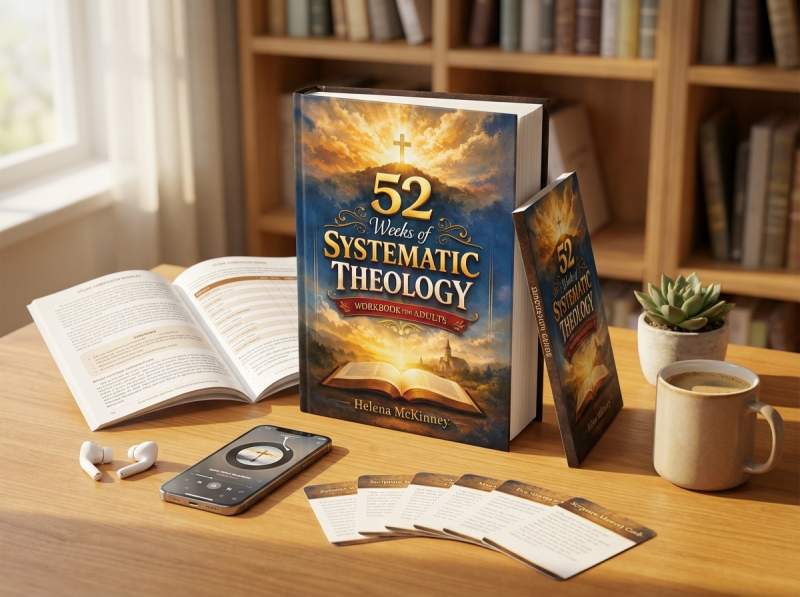
Before talking about any specific product, let's establish what the research — and basic common sense — says about how adults actually learn.
1. It needs to be structured week by week. Not a 1,600-page information dump. Manageable, sequential modules that build on each other — one doctrine at a time, in an order that makes sense.
2. It needs multiple learning modes. Not every adult processes dense written prose efficiently. A complete system gives you the option to read and listen and write and discuss. When you engage material through multiple channels, you retain it.
3. It needs to be completable. If the average adult with a job, a family, and a church community cannot realistically finish the resource within a year of normal life, it's not a learning tool. It's a guilt generator.
4. It needs built-in accountability. Discussion questions. Memory prompts. Study companions. The elements that turn passive reading into active understanding. Without them, you're not studying theology — you're just staring at theology.
5. It needs to be affordable. The person who wants to explain the doctrine of the Trinity to her teenager shouldn't have to choose between her mortgage and a theology education.
None of these criteria are controversial. Educators have understood them for decades. The problem is that nobody in the theology space built a resource that met all five — until recently.
52 Weeks. One System. Every Major Doctrine.
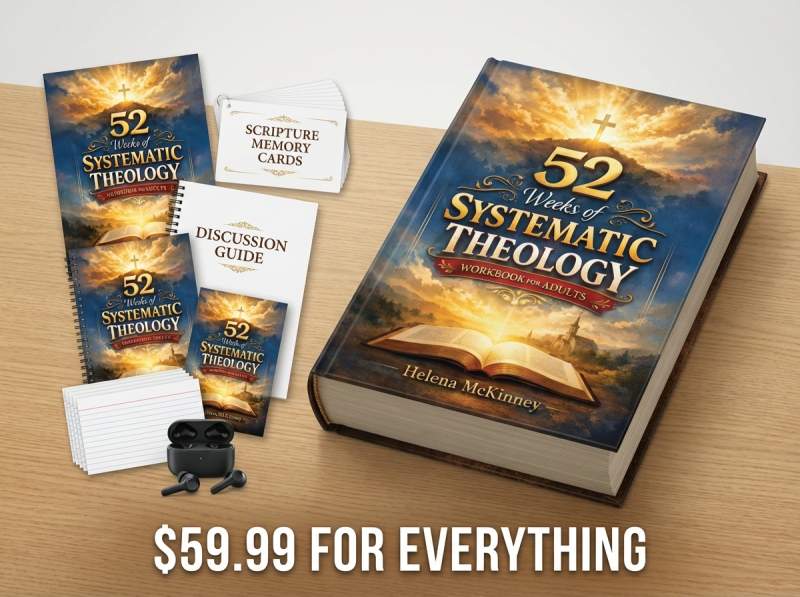
The 52 Weeks of Systematic Theology Workbook was designed to meet every criterion above — and nothing that isn't.
Here's how it works.
Each week covers one focused theological topic. Week 1 assumes you know nothing beyond basic faith. Week 52 doesn't leave a single major doctrine untouched. Over the course of one year, you build a complete framework — the Trinity, the doctrine of God, the person and work of Christ, the Holy Spirit, salvation, sanctification, the church, eschatology — in a deliberate sequence where each week builds on the last.
The workbook itself is 300+ pages. Not 1,600. Not because theology was cut, but because every sentence was written to teach, not to impress. Academic jargon was translated into language a working adult can engage with at the kitchen table after the kids are in bed. Every chapter includes reflection questions, direct Scripture references, and space to write — because you learn doctrine by interacting with it, not by surviving it.
But the workbook is only one piece of what you receive.
When you order, you don't get a book. You get a complete system:
- The 300+ page workbook — 52 chapters, one per week, built for self-study or group use.
- A full audiobook (52 chapters) — listen on your commute, during your morning walk, while folding laundry. Every chapter, read aloud, cover to cover.
- A Printable Study Companion — condensed notes, key terms, and review prompts for every single chapter.
- 52 Scripture Memory Cards — one doctrinal verse per week, designed to anchor each lesson directly in God's Word.
- An Adult Faith Discussion Guide — ready-made questions for couples, small groups, or one-on-one study with a friend or mentor.
- Free shipping.
- A 30-day money-back guarantee.
Seven components. Not seven upsells you discover at checkout. Seven inclusions — all shipped together, all designed to work as a single integrated system.
For the same price as a textbook that gives you nothing but text.
The $59.99 Question
This is where the math gets uncomfortable — for the competition.
Let's lay out the three options a serious Christian has right now, side by side:
Option A: The famous textbook.
$59.99. One book. 1,600 pages of collegiate-level prose. No audiobook. No study guide. No discussion questions. No memory cards. No companion materials. No guarantee. Most buyers quietly abandon it within the first few chapters.
Option B: Seminary.
~$500 per class. One semester. One narrow topic. A fixed schedule you have to build your life around. No physical materials to keep after the course ends.
Option C: The 52 Weeks of Systematic Theology Workbook.
$59.99. A 300+ page workbook covering every major doctrine. A complete 52-chapter audiobook. A printable study companion. 52 Scripture memory cards. An adult discussion guide for couples and groups. Free shipping. A 30-day money-back guarantee.
Read those three options again.
Option A and Option C cost exactly the same amount of money. That is not a marketing claim — you can verify the famous textbook's price on Amazon right now, today. Both products are $59.99.
One gives you a single textbook that most readers never finish.
The other gives you a seven-component learning system designed from the ground up to be completed in one year by a regular adult.
Same price. Completely different experience.
And both of them are a fraction — roughly one-tenth — of a single seminary class.
The question has never been whether you can afford to study theology seriously. At $59.99, you already could. The question was always whether anyone would build something worth that $59.99 for someone who isn't in seminary.
Someone finally did.
"How Do I Know This Isn't Just Another Pretty Package?"
This is the right question to ask. The online space — Amazon especially — is flooded with self-published theology workbooks that look polished on the outside and read like auto-generated filler on the inside. Wide margins. Large fonts. Ninety pages dressed up to look like three hundred.
Here's how you tell the difference:
Physical substance. The 52 Weeks workbook is 300+ pages of actual structured theological content — not 90 pages with decorative borders. The audiobook is 52 full-length chapters — not a 40-minute summary recording. The Study Companion is a real multi-page printable document with key terms, review questions, and chapter summaries — not a single-sheet PDF.
The 52-week structure. This isn't a reference book you dip into randomly when a topic comes up. It's a sequential curriculum with a beginning, a middle, and a clear end. You know exactly where you are. You know what comes next. You know when you're done. That structure is what separates a system from a shelf ornament.
The guarantee. You have 30 full days to use the workbook, listen to the audiobook, try the discussion guide with your spouse or small group, work through the memory cards — and if the experience doesn't meet your expectations, you get your money back. Not store credit. Not a partial refund. Your money, returned, no questions.
This is the resource you wished existed the first time you tried to study theology and discovered your only options were "impenetrable academic textbook" or "shallow devotional that never went deeper than the surface." The 52 Weeks of Systematic Theology Workbook sits in the space between — deep enough to be substantive, clear enough to be finished, and complete enough to actually change how you understand your faith.
You Wanted to Understand Theology. The Only Thing Missing Was a System Built for You.
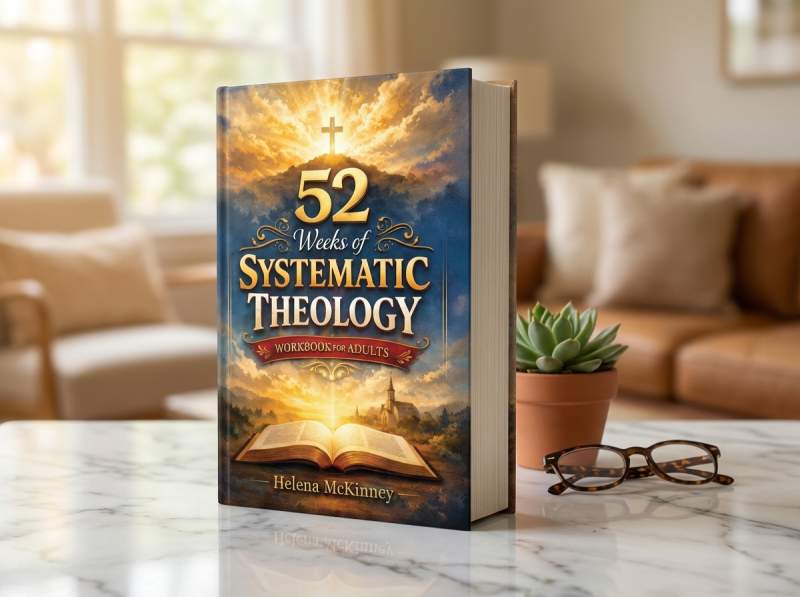
Here's what's included — all for $59.99:
- ✓ 300+ page workbook — 52 weeks of structured, clear, doctrine-by-doctrine theology
- ✓ Full audiobook (52 chapters) — every chapter, ready for your commute or morning walk
- ✓ Printable Study Companion — key terms, summaries, and review prompts for every chapter
- ✓ 52 Scripture Memory Cards — one foundational verse per doctrine, every week for a year
- ✓ Adult Faith Discussion Guide — ready-made questions for couples, small groups, or solo reflection
- ✓ Free shipping — straight to your door
- ✓ 30-day money-back guarantee — if it's not what you expected, you pay nothing
This is the year you stop starting over and actually finish. Not because you try harder. Not because you finally "get serious." Because you finally have the right tool — a system designed for adults who want real depth without an academic gauntlet.
See Everything Included in the 52 Weeks System →
Most readers choose the $79.99 Hardcover Edition — built to last through every chapter and every year you return to it.