They Removed These Books From Your Bible — And Nobody Told You
For every Christian, spiritual seeker, and truth-hungry reader who has always sensed the story wasn't complete — this is what was kept from you.
You've been reading the Bible your whole life. You've sat in the pews, followed along in the devotionals, highlighted the passages. And somewhere along the way — in a sermon, in a footnote, in a late-night conversation — you heard it: there are books that didn't make it in.
Books that were read by the earliest followers of Christ. Books that were cited inside the Bible itself — Jude 1:14-15 quotes directly from the Book of Enoch, a text that isn't in any Bible you've ever owned. Books about the Nephilim, the Watchers, the hidden years of Adam and Eve, the lost gospels of the first believers. Books that councils of men decided, for reasons that were never fully explained to you, that you shouldn't read.
And so you went looking. Maybe it was a TikTok video that stopped you mid-scroll. Maybe it was a sermon that mentioned something and then moved on, leaving you with more questions than answers. Maybe it was just decades of quiet wondering — a 40-year Christian who realized, one day, that nobody had ever handed you the rest of the story.
Whatever brought you here, you started searching. You bought the books. You downloaded the apps. You tried to piece it together. And you hit a wall every single time. The problem was never your curiosity — it was everything you were given to satisfy it.
The Hunger That Never Gets Fed
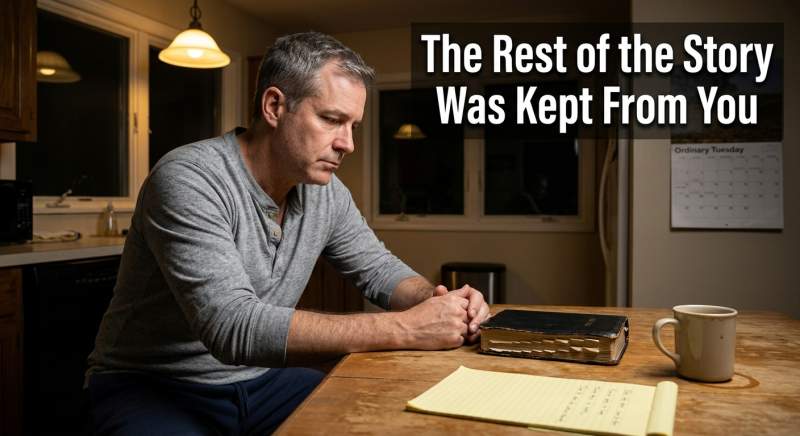
There is a specific, quiet frustration that comes from knowing something is missing but not being able to name what it is.
You've felt it in church when a passage references something — a figure, a story, a prophecy — that doesn't appear anywhere in the Bible you're holding. You've felt it when a friend mentions the Nephilim and you realize you've never actually read that account in full. You've felt it late at night, staring at a Bible that you love but that, somehow, doesn't feel complete. Like reading a novel that's missing chapters from the middle.
"I am a Christian for about 40 years now, and I have heard about the lost books, but until recently, I haven't looked at them seriously until now."
That sentence captures something real. For most people, the looking never happens because life keeps moving and nobody makes it easy. The question stays alive but unanswered — a low hum underneath every Scripture reading, every sermon, every prayer.
The deeper fear — and this is the one most people don't say out loud — is that somebody made a decision on your behalf. That somewhere, in a council room centuries ago, men with political agendas decided what you should and shouldn't be allowed to read.
"I don't know what politics was involved in eliminating these books, but I think they are certainly a must read for those of us who want to know the rest of the story."
That phrase — the rest of the story — keeps appearing. Not because it's a marketing line, but because it's the exact words people use when they try to explain what they've been looking for. The story they were given is real. The faith is real. But the nagging suspicion that there is more — that the canon they received was curated, filtered, edited — is also real.
The hunger is legitimate. What's been missing is a way to actually feed it.
You've Already Tried to Find This — Here's Why It Didn't Work

The people who come looking for the lost books of the Bible are not casual browsers. By the time they're searching, they've already made several attempts. They've tried different books, different editions, different apps, different approaches. And almost every time, something has gone wrong.
The journey usually starts the same way. You discover the Book of Enoch — through a sermon reference, a YouTube video, a footnote. You buy a standalone copy. You read it. It's remarkable. And then you realize it only opens more questions: what about the Book of Giants? The Books of Jubilees? The Nag Hammadi gospels? The Ethiopian Canon? You buy those separately. Now you have three books, four books, five books — a fragmented shelf of partial collections that still doesn't feel complete.
So you upgrade to a "Complete Apocrypha." The word complete is right there in the title. And then, a hundred pages in, you notice something. An entire category of texts — the Gnostic gospels, the Nag Hammadi Library — is simply not there. A reader who discovered this wrote the definitive review of the experience:
"When it says 'The Complete Apocrypha'… that's not entirely correct either. Anything that could be labeled as gnostic is missing."
The "complete" edition wasn't complete. And nobody warned you.
Then there's the physical reality of what you actually receive. Across competing editions in this category, Amazon's own review data tells a precise story: of 187 customer reviews specifically mentioning print size, 129 of them — 69% — are negative. "It is almost too hard to read it because the text is so small." Books that compress thousands of pages into a few hundred by shrinking the font until it requires a magnifying glass. Books you physically cannot read comfortably.
Some readers try free online sources — scattered PDFs, disorganized archives. The content exists but it's hard to read on a screen and lacks any structure that helps a non-academic reader understand what they're looking at. You end up more confused than when you started.
The failure is never the reader. It's the category. For decades, no one has built a solution that actually solves all three problems at once: genuine completeness, physical readability, and enough context to help a devoted but non-scholarly reader actually understand what they're holding. Until now.
The Sacred Library Built What Nobody Else Would — One Complete System for Reading the Texts That Were Removed

The reason every existing solution fails comes down to a problem nobody in the category has been willing to solve honestly.
Most apocrypha compilations are built around a number — 54 books, 100 books, 180 books, 300 books — as if the count itself is the product. But a number is not a reading experience. You can stack 300 texts into a single paperback and still produce something that fails the reader on page one, because the font is unreadable, the structure is absent, and there's no way to orient yourself in what you're holding.
The Lost Apocrypha Bible by The Sacred Library was built around a different question: what does a devoted, curious, non-academic reader actually need to encounter these texts the way they deserve to be encountered?
The answer is a system, not just a compilation. The book itself contains the ancient texts — the Deuterocanon, the Pseudepigrapha, the Gnostic gospels, the Ethiopian Canon, the Enochic literature, the Dead Sea Scrolls material, the Lost Gospels, the Apostolic Fathers — presented with a clean, readable layout that 69% of category buyers have been begging for and never received. Not compressed, not miniaturized, not apologetically formatted. Readable.
But the book is only the beginning. Because the other problem — the one nobody talks about — is that encountering these texts cold, without any orientation, can be bewildering. A 40-year Christian picking up the Book of Enoch for the first time is reading in a tradition that assumes knowledge of Second Temple Judaism and the relationship between this text and the canonical letters that quote from it. Without that context, the experience is impressive but incomplete.
That's why The Lost Apocrypha Bible bundles seven exclusive bonus guides alongside the physical book and a full audiobook:
- The Watchers & Fallen Angels Explained
- The Nephilim & Giants Codex
- Lost Books of the Bible Breakdown
- Apocrypha Timeline & Origins Guide
- Prophecies & End Times Secrets
- Biblical Mysteries & Hidden Knowledge
- How to Read & Understand Apocryphal Texts
That last guide directly addresses the pain one reader captured precisely: "I could not have successfully made heads or tails of The Apocrypha without guidance."
The mechanism is not a bigger number. The mechanism is a complete system: the texts, in a format you can actually read, with the context that makes the reading transformative instead of confusing — in a format you can hold in your hands and also listen to on your commute.
What Actually Happens When You Open This Book

Reading apocryphal texts for the first time is not like reading a new commentary or a theological study guide. The people who have done it reach for a different vocabulary when they try to describe it.
"I was shocked and fascinated. It's really exciting to be able to see what the first to second century Christians believed and how they perceived Christ."
Another reader — someone who came to these texts after decades of conventional Bible reading — described the Book of Adam and Eve in terms that surprised even herself:
"The Adam & Eve book made me cry. I just could not bear the thoughts of seeing them standing in the cave. All alone and in desperate need of God and his presence."
And a reader encountering the Nag Hammadi Library for the first time wrote simply: "It opened up 'a new world' to me."
These are not the reactions of people who found interesting historical information. These are the reactions of people who encountered something that hit with the force of revelation.
The Lost Apocrypha Bible is designed to produce that experience — not accidentally, but intentionally. The clean, readable layout means you can sit with the text at the end of a long day and actually absorb it. The audiobook means you can move through the Enochic literature during a commute or a walk, letting these ancient words work on you the way oral tradition intended. The bonus guides mean that when you hit a passage about the Watchers and want to understand what you're reading in its full historical and scriptural context, you have a resource — The Watchers & Fallen Angels Explained — that speaks in plain language, not academic jargon.
The system works like this in practice. You start with the physical book. You read through the Book of Enoch with clean typography and proper paragraph spacing. You pause at the passage that Jude 1:14-15 quotes and you feel something click into place — the canonical Bible was pointing to this text the whole time. You move into the Gnostic gospels — texts that the majority of competing "complete" editions deliberately omit — and you encounter a vision of early Christian diversity that nobody in your church ever told you about.
You listen to the audiobook on your commute. You pick up the Apocrypha Timeline & Origins Guide and suddenly the relationship between all these texts, spread across centuries and traditions, becomes a coherent map.
Twenty minutes a day. That's all this requires. And the experience readers have reported is not mild intellectual interest. It is transformation.
The Evidence for Why This Works When Everything Else Has Failed

The case for The Lost Apocrypha Bible is not theoretical. It's built on documented, verifiable failures in the category — and a product designed to solve each one specifically.
Start with print readability, because it's the most concrete and measurable problem in the space. Amazon's own AI review summary across KJV Apocrypha editions analyzed 187 customer reviews that specifically mentioned print size. 129 of those reviews — 69% — were negative. The language is consistent and visceral: "It is almost too hard to read it because the text is so small." This is not an edge case complaint. It is the majority experience. A category where seven out of ten print buyers find the physical product difficult to read is a category that has been failing its audience at the most basic level.
The math behind this failure is visible. The leading "180-Book" competitor offers a Kindle edition of 4,066 pages. Its paperback version: 547 pages. That's a 7.4-to-1 compression ratio. Four thousand pages of content, compressed into five hundred and forty-seven physical pages. The arithmetic tells you exactly what is happening to that font.
Then there's the completeness problem. The dominant category player has published editions spanning 54, 100, and 300 books. Across every single edition, they have made the same deliberate editorial decision: all Gnostic content is excluded. No Nag Hammadi. No Gospel of Thomas. No Gospel of Philip. This is not an oversight — it is a policy. And buyers discovered it:
"When it says 'The Complete Apocrypha'… that's not entirely correct either. Anything that could be labeled as gnostic is missing."
The credential problem compounds the trust issue. The leading scholarly-positioned competitor presents its author as a "PhD." Investigation finds: no Google Scholar profile, no ResearchGate listing, no university affiliation, no academic publication record. The PhD is unverifiable. The publisher is a sole-author imprint, with ten or more titles published in a five-month window, all public-domain ancient text compilations.
The Lost Apocrypha Bible addresses all three documented failures directly. Clean, readable layout — designed from the ground up for the non-academic devotional reader, not compressed to hit a page count. Gnostic texts included — the Nag Hammadi, the Lost Gospels, the full breadth of what was removed and why. And a 30-day satisfaction guarantee that carries no conditions, because the product is built to stand behind.
The $59 price against a stated value of $197+ is not an arbitrary marketing figure. The buyer who has already spent $30–$80 piecemeal across three, four, or five partial compilations that still left gaps has already paid more than $59 — and still doesn't have what they were looking for. This is one purchase. One library. Complete.
"But Is This Really Complete — Or Just Another Misleading Title?"

You've been burned before. You know this. You bought the edition that said "Complete" in the title and discovered, pages in, that an entire category of texts was missing. You bought the book with the impressive page count and found that the font required a magnifying glass. The word complete has been stripped of meaning by a category that has used it irresponsibly.
So when you see The Lost Apocrypha Bible, the question forming in your mind is completely reasonable: is this actually different, or is this just another misleading claim?
Here is the honest answer.
No single-volume printed book contains every text ever associated with the broader Apocrypha, the Pseudepigrapha, and the Gnostic traditions — the full scholarly universe spans thousands of texts across dozens of linguistic traditions and centuries of transmission. Anyone claiming absolute completeness is either unaware of the full scope of the material or is not being straight with you.
What The Lost Apocrypha Bible delivers is documented, specific, and verifiable: the Deuterocanon, the Pseudepigrapha, the Gnostic gospels and Nag Hammadi Library (which the category's dominant publisher deliberately excludes), the Ethiopian Canon, the Enochic literature including all three Books of Enoch, the Dead Sea Scrolls material, the Lost Gospels, the Pilate Cycle, and the Apostolic Fathers. These are not abstractions — they are named texts you can look up, confirm, and compare to competing editions.
The Gnostic inclusion matters specifically because it is the single most documented omission in the competing marketplace. The Gospel of Thomas, the Gospel of Philip, the Gospel of Mary Magdalene — these are the texts that early believers read, that were suppressed at the Council of Nicaea and the subsequent canon-formation councils, and that no mainstream "complete apocrypha" collection from the dominant publisher has ever included. These are in The Lost Apocrypha Bible.
And the 30-day satisfaction guarantee means you're not trusting a claim — you're making a risk-free test. If you open this and it doesn't deliver what's promised, you get your money back. No forms, no conditions.
But here is what will actually happen: you will open to the Book of Enoch and realize you can read it comfortably. You will reach the Gnostic gospels and encounter texts that the "complete" edition you may have tried before deliberately withheld. You will pick up the How to Read & Understand Apocryphal Texts bonus guide and realize, for the first time, that someone has actually thought about the reader's experience — not just the page count.
The question isn't whether this is complete. The question is whether this is the most complete, most readable, most supported reading experience in the category. The answer to that question is yes.
What Readers Say When They Finally Find the Rest of the Story
"The Adam & Eve book made me cry. I just could not bear the thoughts of seeing them standing in the cave. All alone and in desperate need of God and his presence."
— Luis A. C., Verified Reader
"I was shocked and fascinated. It's really exciting to be able to see what the first to second century Christians believed and how they perceived Christ."
— Verified Amazon Reader, Lost Scriptures
"I don't know what politics was involved in eliminating these books, but they are certainly a must read for those of us who want to know the rest of the story."
— 40-Year Christian, Verified Reader
"The Nag Hammadi Library opened up 'a new world' to me. These writings that did not find their way into our Bible… I had no idea they existed."
— Verified Reader, Amazon UK
The Books That Were Removed From Your Bible — Restored in One Complete, Readable Volume
For every reader who has spent years wondering what was kept from them. For every believer who bought the "complete" edition and discovered it wasn't. For everyone who tried to piece this together across five different books and still felt like something was missing. This is what you've been looking for.
What you receive with The Lost Apocrypha Bible:
- ✦ The complete physical book — Deuterocanon, Pseudepigrapha, Gnostic Gospels, Ethiopian Canon, Enochic Literature, Dead Sea Scrolls material, Lost Gospels, Apostolic Fathers — in a clean, readable layout designed for devoted readers, not academics
- ✦ The full audiobook — every text in audio format, so you can encounter these words the way they were meant to be encountered: spoken aloud
- ✦ All 7 exclusive bonus PDF guides — including The Watchers & Fallen Angels Explained, The Nephilim & Giants Codex, Biblical Mysteries & Hidden Knowledge, and How to Read & Understand Apocryphal Texts — delivered instantly upon purchase
- ✦ The Gnostic gospels included — the texts that the dominant "complete" publisher deliberately omits, restored to where they belong
- ✦ A 30-day satisfaction guarantee — no conditions, no questions, no risk
The buyer who has already spent $30–$80 across three or four partial compilations that still left gaps has already paid more than $59 and still doesn't have what they're looking for. One purchase. One complete system. The rest of the story.
The total value of this bundle — book, audiobook, and all seven bonus guides — is $197 and above. Today, through this offer, the complete system is available for $59. That gap closes when this offer period ends.
✦ YES — I Want The Lost Apocrypha Bible + All 7 Bonus Guides for $5930-Day Satisfaction Guarantee · Instant Digital Delivery · Premium Physical Edition Ships to Your Door