Before You Choose Another Prayer Resource, Ask One Question: Will It Help You Begin Tonight?
For Christians researching prayer guidance because the words feel hard to find in the moment—and "just read this" is not enough of an answer.

There is a particular kind of evening when you mean to pray—and still cannot begin.
Maybe your Bible is open. Maybe there are notes from a sermon beside it. Maybe you have a few tabs open, a saved video, a prayer app, a book you bought years ago, and a dozen good intentions.
None of that changes the question sitting in the room with you:
What do I say now?
Not eventually. Not after a long course. Not after you have compared every teacher, listened to every lesson, or figured out the perfect way to pray.
Tonight.
The difficulty is not always a lack of faith. Often, it is the opposite. You care enough that you do not want to fill the silence with words that feel borrowed, vague, or disconnected from what you are honestly carrying.

You may have read a written prayer and felt the tension immediately:
"I feel like I am reading from a script and not actually communicating with the Lord."
That is not a small objection. It is the whole issue.
A prayer can be beautifully written and still leave you wondering whether you are simply reciting someone else's language. A teaching can be thoughtful and still be useless at the exact moment you need a sentence to start with. A screen full of options can make the problem worse: now you are searching, comparing, and second-guessing before you have even prayed.
And the present cost is subtle.
You postpone the moment. You tell yourself you will come back when you feel more focused. You reach for the phone, then get pulled into something else. Or you say a few rushed words and walk away feeling as though you never really arrived.
The need is not for a performance.
It is for a next step that feels sincere enough to take.
The endless-content model was not built for the moment you are in.

The problem is not that there is no prayer content available.
There is plenty.
Free prayers. Video teachings. Downloadable guides. Apps. Courses. Sermon clips. Long reading lists. Entire libraries of material that may be useful someday.
But the endless-content model creates a frustrating gap: it gives you more to sift through precisely when you need less friction.
A long teaching sequence may help someone study a subject over time. An app may be useful in a particular season. A free search result may offer a starting point. None of those options are inherently wrong.
But when the real question is, "How do I pray through this tonight?" the first task should not be sorting through a library.
That is where many prayer resources quietly fall short for a researcher.
They offer a broad collection without making the next step clear. They give you language, but not a way to orient yourself inside it. They ask you to search, scroll, save, compare, and decide—before you have had the chance to be still.
And when the resource is a written prayer book, there is another tension: does it help you speak honestly, or does it make you feel as though you are merely repeating lines?
That concern is worth taking seriously before choosing anything.
A useful written prayer should not turn you into a spectator of your own prayer life. It should help you begin, then leave room for your own voice.
The endless-content model tends to confuse abundance with usefulness.
They are not the same thing.
A shelf full of material can still leave a person stuck at the first sentence.
The better question is not, "Does this resource contain enough?"
It is:
Can I understand what it is for, find the part that fits this moment, and make it personal enough to pray?
That standard changes how you evaluate every book, app, lesson, and guide in this category.
You may not need more prayers. You may need a clearer way to reach one.

The category has trained people to look for more content: more lessons, more declarations, more audio, more teaching, more material to save for later.
But a person facing a real moment of pressure is not usually asking for a larger library.
They are asking for orientation.
Can it help you move from "I do not know what to say" to one honest next prayer?
That is the structural idea behind a resource worth keeping nearby. Not a book you are expected to complete from front to back, but a practical reference point you can return to when the need is specific and your words feel scattered.
Here is what that idea looks like in practice:
Do not begin by trying to pray about everything at once.
Name the pressure that is actually in front of you.
Ask one smaller question: "What is the next prayer I can pray honestly right now?"
Let a written prompt give you a starting sentence, not a mask.
Pause where the words become personal.
Add your own names, fears, hopes, and requests.
When your words run out, return to the next clear line.
The point is not to sound impressive. The point is to begin.
That is a different standard than "Does this sound powerful?"
It is also a better standard than "Does this contain a lot?"
A serious prayer resource should make its practical structure visible. It should let you inspect whether the material is organized in a way that matches real-life use—not just attractive cover language.
Because when the hour is late and the mind is crowded, the right resource is not the one that gives you the most to consume.
It is the one that helps you take the next faithful step.
To review the available formats and the role of each included resource, see what is inside.
Evaluate the resource as a tool—not just a title.

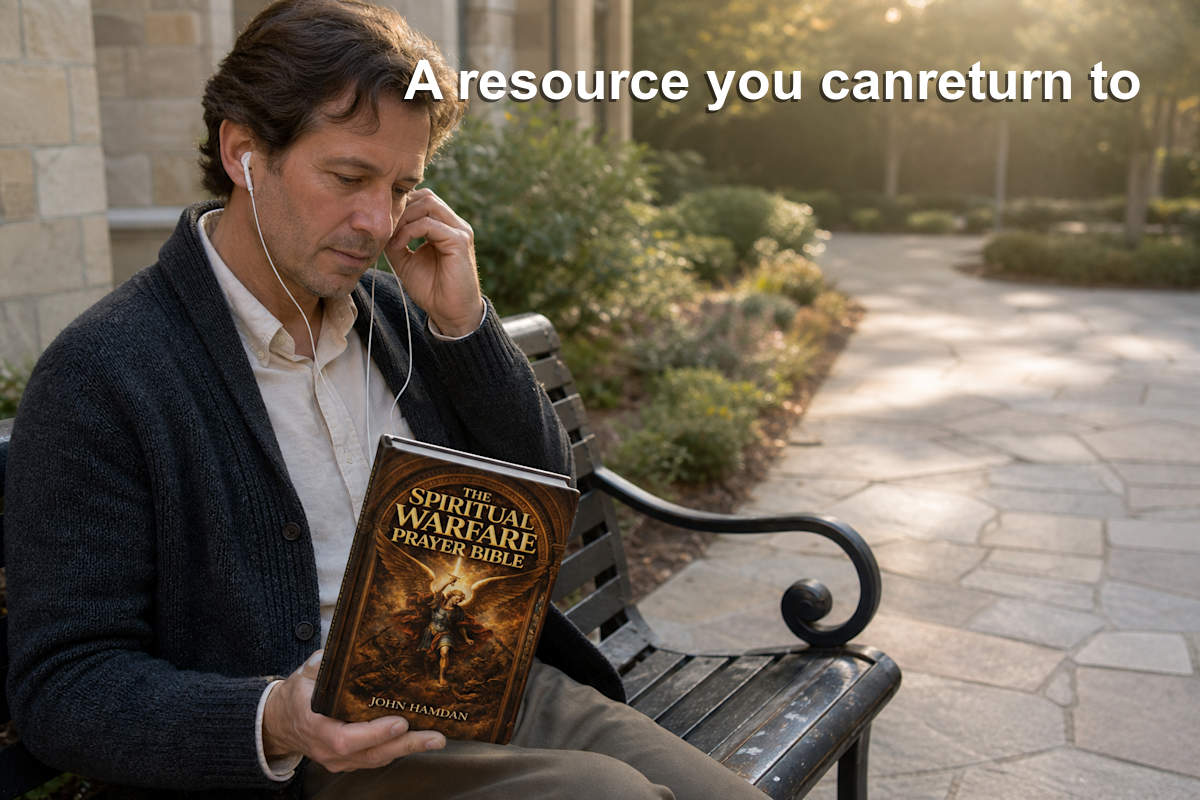
That is the lens for evaluating The Spiritual Warfare Prayer Bible by John Hamdan.
It is presented as a physical prayer resource, available in paperback and hardcover, with an audiobook version and three practical companion resources: the 30-Day Spiritual Warfare Battle Plan, the Emergency Prayer Playbook, and Spiritual Armor Declaration Cards.
The important part is not merely that these pieces exist.
It is whether each one has a clear job in your life.
The printed book should be evaluated as the resource you can keep nearby. The audiobook should be evaluated for moments when reading is inconvenient. The practical PDFs should be evaluated by whether they give you a useful structure or prompt when you need one.
Three ways to check it for yourself
Look for the route
Examine how the material is organized. Can you see how a reader would move from a present concern to a useful starting point?
Match each format
Ask what the physical book, audiobook, battle plan, emergency playbook, and declaration cards are each meant to do.
Read the details
Review the available format information, the 30-day guarantee terms, and the full breakdown before making a choice.
A prayer resource should earn trust by being inspectable.
There are no shortcuts around this.
For a product in a faith category—especially one involving spiritual warfare—the reader has every reason to be careful. You are not choosing a decorative object. You are considering words you may turn to in private, under pressure, when you want to pray with more intention.
That is why trust should not rest on a dramatic claim, a polished cover, or borrowed authority.
It should rest on what you can actually examine.
The confirmed format facts are straightforward:
A physical edition is available in paperback or hardcover.
An audiobook version is included with the offer.
The resource is paired with a 30-Day Spiritual Warfare Battle Plan.
It also includes an Emergency Prayer Playbook.
It includes Spiritual Armor Declaration Cards.
Those details do not answer every theological question. They should not.
But they give you a more practical basis for evaluating whether this is the kind of resource you would genuinely return to: a printed book, an audio option, a structured plan, an emergency reference, and printable prompts.
"I just don't enjoy praying with my phone."
That does not mean digital resources are wrong. It means the medium can change the experience.
A physical prayer resource can create a different kind of pause: the phone is not the only door into the moment, and the material can remain within reach without becoming another notification stream.
The right reader is not looking for a quick spiritual fix.
They are looking for a practical resource they can examine carefully—and return to when the words are hard to find.
To see the full resource breakdown, see what is included.
"Why choose a paid prayer resource when free prayers are everywhere?"

It is a fair question.
Free material can be helpful. A pastor, church community, trusted teacher, or existing prayer practice may already be an important part of how you seek guidance. A book should not pretend to replace any of that.
The reason to evaluate a paid physical resource is not because free prayers have no value.
It is because some readers want an organized, tangible reference they can keep, revisit, listen to, and use across different moments—without having to start the search from scratch every time.
The offer includes a 30-day guarantee, which gives you time to inspect whether the format, structure, and companion resources actually fit the practical role you need them to play. Review the full terms before deciding.
If you are simply looking for a dramatic promise, this is not the standard to use.
If you are serious about finding a clearer place to begin when prayer feels difficult, it is worth looking closer.