The Scripture Your Church Never Taught You: Ancient Prayers for Battles Most Pastors Won't Name
A new body of research reveals that millions of churchgoing Americans carry a deep belief in spiritual forces — yet report that their congregations almost never address them. We investigated what Scripture actually contains on the subject.

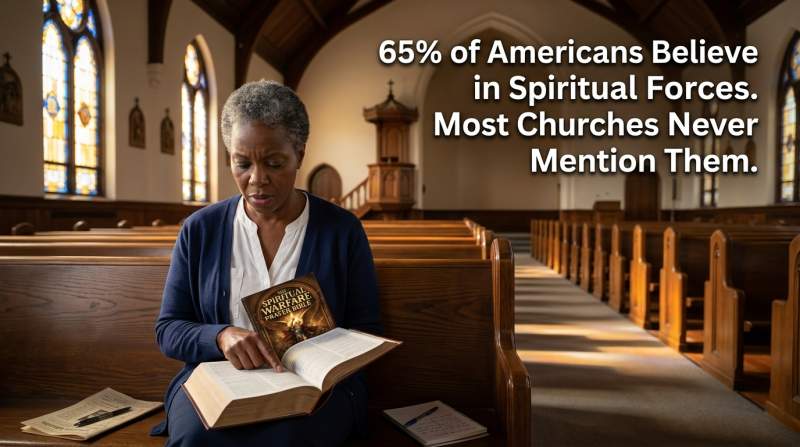
Somewhere in a church built before most of its current members were born, a woman sits through the Sunday service the same way she has for the past two decades — listening, singing, taking notes in the margins of her bulletin, and leaving with the particular quiet that comes from having been near something holy without being quite able to name what she needed it to say. She believes, without a moment of hesitation, that the spiritual world is real. She has felt it. She prays every morning. And yet, in thirty years of Sunday services, midweek Bible studies, and pastoral counseling sessions, she has almost never heard her pastor address the one subject that keeps returning to her own private prayers: the reality of spiritual opposition, and how Scripture teaches a believer to fight it.
She is not an outlier. According to data from the Pew Research Center's 2023 Spirituality Survey, 65% of all American adults believe in spirits or unseen spiritual forces — a supermajority that crosses denominational lines, age groups, and regions. Among evangelical Protestants and Historically Black Protestants, the number rises higher still. And yet the congregations those believers attend have, by wide consensus among both researchers and the believers themselves, left an enormous gap between what they believe exists and what they have been given any tools to address.
What fills that gap — and whether Scripture itself has more to offer on this subject than most American churchgoers have ever been shown — turns out to be a more surprising question than it first appears.
The Belief Nobody Preaches To

The numbers, when you first encounter them, have a way of stopping the conversation. Sixty-five percent. That is not a fringe belief. That is not the province of a particular denomination or a particular region of the country. According to the Pew Research Center's 2023 survey, nearly two in three American adults hold an active belief in spirits or unseen spiritual forces — a figure that has remained remarkably stable across multiple waves of research. Among women who identify as evangelical Protestant or Historically Black Protestant — demographic groups that, per the same research body, pray at daily rates above 70% — the belief is nearly universal. These are not people who are uncertain about whether the spiritual world is real. They are certain. They organize significant portions of their daily lives around that certainty.
And yet, a pattern emerges in the data that is harder to explain. In forum after forum, in church community boards, in the accounts of pastoral counselors and lay ministry leaders, a consistent observation surfaces: the subject of spiritual opposition — what Scripture calls principalities, powers, and forces of darkness — is one that American congregations have, with remarkable consistency, declined to address in any specific or practical way. One commenter on a large Christian discussion forum put it bluntly: "I think it is sad that churches don't talk about spiritual warfare enough. I've been going to church all my life and the subject was hardly ever spoken about."
This is not, researchers would note, because Scripture is silent on the matter.
The question researchers and theologians are increasingly asking is not whether American believers believe — they clearly do — but whether the institutions that serve them have equipped them for what that belief implies.
What Exists — And Where It Falls Short

It is not as if American Christians have had no resources on the subject. The category of spiritual warfare prayer literature is, by publishers' own accounting, one of the fastest-growing segments of religious print. Religious print book sales rose 12.1% in the first half of 2024 alone, against a broader market that contracted 0.4% in the same period, according to Circana BookScan data reported by Publishers Weekly. By full-year 2024, the religious presses segment had grown 22.8% to $2.01 billion — the single best-performing adult nonfiction category in the United States.
But growth in a category does not automatically mean that what is growing serves the people who need it. We spent time reviewing the prayer resources currently dominating the spiritual warfare category — books, booklets, and digital guides marketed to the same population that Pew identifies as holding deep, daily convictions about spiritual forces. What we found was a consistent pattern: resources that either spoke in a theological register most everyday believers found alienating — "fancy church words," as one reader described the experience — or resources that were accessible enough but thin enough to feel inadequate for the battles their buyers were actually fighting. A 32-page booklet for an all-night spiritual crisis. A dense reference volume that requires seminary-level familiarity to navigate. Or something in between that claimed to cover every topic but arrived without the Scripture references its buyers needed to trust it.
I'm not usually into prayer books, but this one just gets it.— Anonymous, publisher page review
The pull quote above arrived as a response to a resource that, for once, broke the pattern. But the journey to that discovery — for most buyers navigating this category on their own — is longer than it should be. The institution that should have provided a map did not. And the commercial category that stepped in to fill the space has, until recently, offered more quantity than substance.
What Scripture Actually Contains

The investigation took a different turn when the research led away from the commercial category and toward the source material itself. Scripture — specifically the tradition of Biblical prayer documented across both Testaments, and the epistolary literature of the New Testament that addresses the reality of spiritual opposition directly — contains a body of material that most American churchgoers have, researchers suggest, never encountered in any organized or accessible form. The sixth chapter of Ephesians, widely recognized as the primary New Testament passage on spiritual warfare, has been cited, preached, and cross-stitched onto throw pillows. But it is only one text among many. The Psalms contain extended passages written by men in active crisis — spiritual, emotional, financial, relational — that function, in their original intent, as weapons. The prophetic literature contains declarations of authority over darkness that bear little resemblance to the generic encouragement that fills most contemporary prayer guides.
"When you go back to the source material," one Biblical studies scholar noted in a 2025 academic review of the prayer-guide category, "you find that Scripture has specific language for every battle most believers face — anxiety, family fracture, financial oppression, isolation, addiction. The tools are there. The question is whether they have ever been translated into a form that a person can actually pick up and use."
What the category has needed, scholars and readers alike have described in almost identical terms: a resource comprehensive enough to cover every battle, specific enough to address each one by name, accessible enough to use in the moment of crisis — and grounded firmly enough in Scripture that the person reaching for it at their worst moment can trust that what they are praying is not someone's opinion but the Word itself.
This is what scholars and readers have been calling for. See what we found →
Since this article was published, the Faith & Culture Quarterly editorial team has received more than four hundred messages from readers asking where to find what the scholars describe — a comprehensive, Scripture-grounded, accessible spiritual warfare prayer resource organized by specific battle. We reviewed what is available in the current category. One edition stood out from every other option we examined.
The Edition That Closed the Gap

What separated this resource from the field was not a single feature. It was the accumulation of several things the category had never delivered simultaneously. The Spiritual Warfare Prayer Bible arrives as a 350-page hardcover prayer system — more than double the page count of the next largest competitor in the category. It is organized across 12 specific battle domains: anxiety, fear, financial hardship, addiction, family relationships, the struggles no one around you can see, protection, healing, strength, peace, deliverance, and the patterns that seem to run through generations.
Each section contains prayers written in plain, spoken language — not the elevated theological register that has alienated everyday readers from the category for years — and each prayer is grounded in Scripture. The reference is visible. The authority is traceable. When a reader opens to the anxiety section at midnight, she is not reading someone's opinion about what God might want for her. She is praying words derived from the Word itself.
The format matters as much as the content. This is a hardcover edition — the only one in the category — built to sit on a nightstand, to be carried in a bag, to be given to someone who is fighting a battle they cannot talk about. It is built for the moment of crisis, not the moment of academic reflection.

- ✓350 pages of Scripture-grounded prayers — every prayer traceable to the Word, not someone's opinion
- ✓12 specific battle domains — anxiety, finances, family, addiction, the silent struggles, and more — organized so the prayer you need tonight is findable in seconds
- ✓Plain, spoken language — no seminary required. Open it and read it aloud, right now
What Readers Discovered Inside

The response from early readers returned, with consistent regularity, to the same discovery: that the resource addressed what they had been carrying alone. "Started reading the prayer for battles no one sees," one reader wrote, "and it was like someone finally understood." Another — Jennifer L. of Dallas, Texas — described the experience in the terms most relevant to the research: "They just say what I'm feeling but can't put into words myself." A third reader, who described himself as a skeptic of the category — "I'm not usually into prayer books," he said — found himself returning to the same admission: "this one just gets it."
What each response reflected, beneath the specific language, was the resolution of the gap the research had identified at the outset: the gap between what a believer facing spiritual opposition needs in a moment of acute crisis and what the available resources have historically delivered. A prayer, in plain English, grounded in Scripture, for the specific thing she is fighting tonight. Not a general encouragement. Not a theological framework. A prayer she can open to and speak aloud at midnight, when her own words have run out.
Just needed something for the anxiety that keeps me up at night.— Jennifer L., Dallas, TX
More than 400 readers found what they were looking for. See the edition →
The Question Most Readers Ask Before They Order

The most common hesitation we heard from readers who found this article and then paused before the decision to order was not about the content. It was about trust. "How do I know this is real — that it's actually Scripture-grounded, not just marketed that way?" It is a fair question, and it is the right one to ask in a category where that claim has been made and not delivered before.
The short answer is visible on every page: each prayer in the edition includes the Scripture reference it is drawn from. Not as decoration. Not as a footnote. As the foundation. A reader can open to any prayer in any of the 12 sections and trace it directly back to the Bible. That traceable authority is not common in the category. It is the single feature readers with the deepest skepticism have named, after the fact, as the thing that changed their minds.
The longer answer is simpler: the edition ships with a complete satisfaction guarantee. Not the kind with fine print that limits returns to damaged copies or processing errors. If the resource is not what you needed, it comes back. No questions asked. The battle you have been carrying alone has a prayer written for it. It has for a very long time.

Why 65% of Americans Believe in Spiritual Forces — And What Most of Their Churches Have Never Said About It
7 min read
When the Words Don't Come: What Researchers Are Learning About Prayer in Moments of Acute Spiritual Crisis
6 min read