You've Sat in the Pew for Years. But If Someone Asked You to Explain What You Just Heard — Could You?
A quiet truth most churchgoing women carry alone — and the one thing that finally changes it.


There's a version of this that sounds familiar. Sunday morning. You find your seat. You open the bulletin. The worship team plays, and you know the words. The pastor opens Scripture and begins to teach, and you follow along — nodding, underlining, writing something in the margin that feels important in the moment.
And then, somewhere around the third point of the sermon, you realize you don't actually understand what he's talking about. Not the background. Not why this particular book was written. Not what was happening in the culture when these words were first spoken. Not what connects this passage to the one three chapters earlier, or the one that came up in last week's lesson. You close your Bible. You fold your bulletin. You drive home. You've done this for years. Maybe a decade. Maybe longer.

And here is the part that stays with you, quietly, on the drive home and in the space before sleep: everyone around you seems to understand. The woman across the aisle who always has something thoughtful to say during the discussion portion. The friend in your Wednesday night group who can trace a theme across four different books. Your pastor, obviously. Even people who seem far less serious about their faith than you are. You nod. You smile. You participate at the surface level. You have learned, over years of practice, how to move through church life in a way that conceals the gap.
Why Everything You've Tried Has Left You in the Same Place

Before you look at another Bible study guide — including this one — there's something you need to understand about why the previous ones didn't work. It wasn't the Bible. It wasn't your intelligence. It was the format.
The app gave you access. You downloaded YouVersion — the same app that now has over a billion installs worldwide. You opened it. You read a verse-of-the-day. You watched it sit on your phone next to Instagram and TikTok. A billion people downloaded it. Only 20% of Americans have read the entire Bible. Access isn't the problem. The reading plan gave you a schedule. January 1st, you started. Somewhere around Leviticus, you stopped. Not because you aren't serious. Because the plan gave you pages with no context, a calendar with no mercy, and a guilt spiral every time life interrupted. The church group gave you community. What it didn't give you was comprehension. "99% of our study is made up of different women assigned reading paragraphs from the workbook" — that's not a harsh criticism. That's what one women's ministry leader documented about her own program. The devotional on your nightstand gave you someone else's feelings about the Bible. Not the Bible itself, explained in a way that made it accessible to you.
It felt like everyone understood the Bible except me.— Verified reader, Cups to Crowns blog
None of these failed because you weren't trying hard enough. They failed because every single one of them gave you content — and none of them gave you a method. If you're evaluating a new resource right now, that's the question that matters: Does it come with a repeatable method, or just more content?
The Number That Changes How You See This

Let that 61% figure sit for a moment. Six out of ten people sitting in church pews on any given Sunday are not reading the Bible on their own. They are not studying it. They are not engaging with it between services. They are showing up, participating, and going home — carrying the same quiet uncertainty you carry. You assumed you were the exception. The one person who should understand but doesn't. You are the majority.
The American Bible Society's 2025 research found that 51% of Americans wish they read the Bible more. Among people who are open to the Bible but not yet deeply engaged, that number rises to 80%. Eight out of ten. The gap between wanting to understand the Bible and actually understanding it is not a personal failing. It is the single largest unresolved problem in American Christian life — and the reason it remains unresolved is simple: most of the resources available were built around content, not comprehension.
— American Bible Society, State of the Bible 2025, Chapter 1The question you're actually trying to answer when you search for a Bible study guide isn't "which book covers the most material?" It's: "Which one will finally make it click?"
The problem was never your intelligence, your faith, or your commitment. If you've been carrying the shame of feeling behind, know this: you are not uniquely unqualified. You are part of a majority that has simply never been handed a method that works. The Bible Clarity Study Guide was built for exactly this moment →
What Finally Makes the Difference
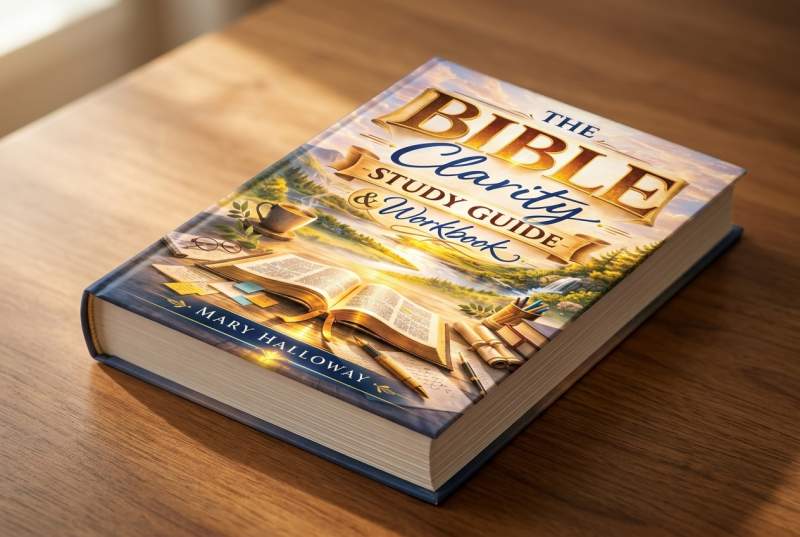
The Bible Clarity Study Guide & Workbook by Mary Halloway was built around a single premise: the problem was never the Bible. It was the absence of a repeatable method. Every lesson in the guide follows the Bible Study Method Blueprint™ — a five-step system designed for the person who has sat in services for years and never felt confident studying alone: Read → Context → Reflect → Apply → Journal. Each step has a specific purpose. Read anchors you in the actual text. Context gives you the historical and cultural background that makes the passage make sense. Reflect moves from comprehension to meaning. Apply connects Scripture to your life without forcing the connection. Journal gives you structured space to record what you understood — so the learning accumulates instead of evaporating.
The guide covers all 66 books of the Protestant Bible. Every purchase includes a full audiobook, a Quick Start Plan that tells you exactly where to begin, the Blueprint™ as a standalone reference, a 40-page Journal Pack, and additional guided resources. It is self-paced — no schedule, no group, no deadlines.
How to Verify This Resource Before Purchasing — 3 Steps
Check the Method
Does the guide teach you how to study, or does it just give you study content? Look for a named framework. The Bible Study Method Blueprint™ is documented and included as a separate PDF with your purchase.
Check the Starting Point
A resource that begins with Genesis and a 365-day plan is structured for completion anxiety, not comprehension. The Quick Start Plan included with this guide answers "where do I begin?" before you open the first chapter.
Check the Guarantee
The Bible Clarity Study Guide & Workbook includes a satisfaction guarantee at every tier. If it doesn't work for you, you're covered. That removes the risk of another unfinished resource on your shelf.
What People Searching for This Found

The transformation language that surfaces in reviews of resources like this one is remarkably consistent. It doesn't sound like a press release. It sounds like relief.
IT'S NOT OVERWHELMING, DAUNTING or DISCOURAGING — all things I have felt attempting to complete previous Bible-in-a-Year plans.— Verified reader review, Goodreads
Notice also what isn't in those reviews: no mention of feeling behind. No mention of shame. No mention of sitting in church hoping no one asks them a question they can't answer. The "finally" is the data point that matters — it signals that the person searched, tried, and failed before. And this time, something different happened. That feeling doesn't have to follow you into another resource. See the Bible Clarity Study Guide & Workbook →
"I've Bought Bible Study Books Before and Didn't Finish Them. What Makes This Different?"

That's the right question to ask — and the honest answer is: the format. Every previous resource you didn't finish was built for consumption: read the chapters, answer the questions, repeat. When life interrupted — and it always does — there was no re-entry point. You fell behind, and then staying behind felt easier than catching up.
The Bible Study Method Blueprint™ solves this structurally. Each session using the five-step method — Read, Context, Reflect, Apply, Journal — is complete in itself. There is no "behind." There is no schedule. You open it when you're ready, work through one book, and close it. The next time you open it, the method picks up exactly where you are.
The satisfaction guarantee means the risk of trying it is removed. If it doesn't work for you, you're covered. This is the one resource where trying it costs you nothing if it doesn't deliver.