One Billion Downloads. One in Five Has Read It. The Quiet Crisis Nobody's Talking About.
A new wave of data is revealing something unexpected about American Bible engagement — and the explanation is simpler, and stranger, than anyone expected.


In November 2025, the company behind the world's most popular Bible app announced a milestone that almost no one paused to examine. YouVersion — the app that puts an entire Bible library on any smartphone — had surpassed one billion device installs worldwide.
One billion. The number is so large it collapses into abstraction. One billion is roughly one in eight people on earth. It is more than three times the entire population of the United States. It is, by almost any measure, one of the most successful distribution events in the history of religious publishing.
And yet. Lifeway Research, in a nationally representative study of one thousand American adults, found that only 20 percent of Americans have read the entire Bible. Not this year. Not recently. Ever. In a country where 62 percent of adults identify as Christian — where church attendance, Bible sales, and Bible study curriculum purchases are all rising simultaneously — four out of five people have never read the book that sits at the center of their faith. Many of them have it on their phone right now.
The Number That Changes the Question

The natural assumption is that this gap is a motivation problem. People mean well but don't follow through. Life gets busy. Intentions drift. This is the explanation most commonly offered, and it is almost certainly incomplete.
Consider the data more carefully. The American Bible Society's State of the Bible 2025 report found that 51 percent of all Americans wish they read the Bible more. Among the segment researchers call the "Movable Middle" — people who express genuine openness to the Bible but are not yet actively engaged with it — that figure rises to 80 percent. These are not people who are indifferent. They are people who are trying, and for whom something is consistently not working.
The numbers form a pattern that is hard to ignore. One billion downloads. Eighty percent who want to read more. Twenty percent who have read it through. Somewhere between download and comprehension, something is being lost — and it is not ambition. What researchers, educators, and publishing analysts have increasingly identified as the missing variable is not access, and not intention. It is method. The Bible is not a novel. It is not a self-help book. It is a library of 66 distinct texts — poetry, law, prophecy, history, letters — spanning centuries, cultures, and literary forms that have no direct equivalent in modern reading life. Downloading it does not come with instructions for how to read it. Opening the app does not provide context for what you are reading. And without context, even the most motivated reader will eventually close the app and move on.
A billion people have the Bible on their phone. Most have never read past Genesis. The problem was never access.
What "Available" Actually Looks Like

Walk into any Christian bookstore, search "Bible study" on any major retailer, or scroll through a Sunday morning church handout, and you will find an extraordinary range of options. Devotionals. Reading plans. Video series. Study bibles with footnotes. Workbooks. Apps. Curricula designed for groups of six to twelve who meet on Wednesday nights in church fellowship halls. The category is genuinely vast. And yet the 20 percent completion figure has not moved meaningfully in recent years. More resources has not produced more comprehension.
When this publication reviewed the landscape of currently available approaches, a consistent structural limitation emerged. The large majority of popular Bible study resources share a common design choice: they prioritize the author's voice over the biblical text itself. A reader moves through a chapter, encounters the author's story, is offered a reflection question about her own feelings, and moves on — having spent perhaps 200 words in the actual scriptural text and 1,800 words in commentary and personal narrative. The Bible is present, but it is mediated.
I find many Bible studies focus more on the author telling stories… and then asking the reader how they feel.— Reader, Reddit r/Bible
A second limitation is structural rather than content-based. Reading plans — the "Bible in a Year" format that reliably spikes in January — require consistent daily engagement on a fixed schedule. Miss three days and the psychological weight of catching up becomes its own barrier. The plan that was meant to remove obstacles becomes an obstacle. A third limitation is the group dependency built into most church-based Bible study curricula. One longtime women's ministry observer described the pattern plainly: in her experience, a large majority of the study session consists of women taking turns reading paragraphs aloud from a workbook, rather than engaging directly with the text. The resources exist. The gap persists. The common denominator across all these approaches — apps, reading plans, group curricula, author-commentary devotionals — is that they provide content without a replicable method the reader can use independently, at her own pace, without a group or a schedule.
What Researchers Say the Solution Looks Like

When faith education researchers and publishing analysts look at the data, a consistent recommendation emerges. The readers who sustain engagement with the Bible over time are not the ones who found more motivation. They are the ones who found a method — a repeatable process they could return to independently, regardless of schedule, group, or external structure.
The American Bible Society's research points toward what they call "Scripture Engaged" practice: consistent, structured, personal engagement with the biblical text as distinct from passive exposure. The Pew Research Center's 2023–24 Religious Landscape Study found that 61 percent of American Christians seldom or never read Scripture outside of religious services — not because they don't want to, but because the conditions required by most available resources (groups, schedules, guided sessions) are simply not present in their daily lives. What the data suggests a functional approach requires is deceptively simple: context before content, structure before reading, and a method that makes each individual session complete in itself — so that someone who opens a resource on a Tuesday night, reads for thirty minutes, and closes it again has actually done something, rather than simply fallen further behind a schedule.
Bible sales in the United States reached 19 million units in 2025, up 12 percent from the previous year, according to Circana BookScan data reported by Publishers Weekly. Religious books as a category posted the largest sales increase of any category tracked by the Association of American Publishers in 2024 — a 22.8 percent year-over-year rise. Americans are buying more Bibles, downloading more apps, and investing more in religious resources than at almost any point in recent memory. The question the data raises is whether buying more of what hasn't worked will produce a different result — or whether the gap between access and understanding requires a fundamentally different approach.
This is what researchers and educators have been pointing toward for years. See what we found →
When this article was first published, our editorial team received several hundred messages from readers asking the same question — where does a resource like this actually exist? We reviewed a number of options on the current market. One stood out in a way that surprised us.
The Edition That Passed Our Review
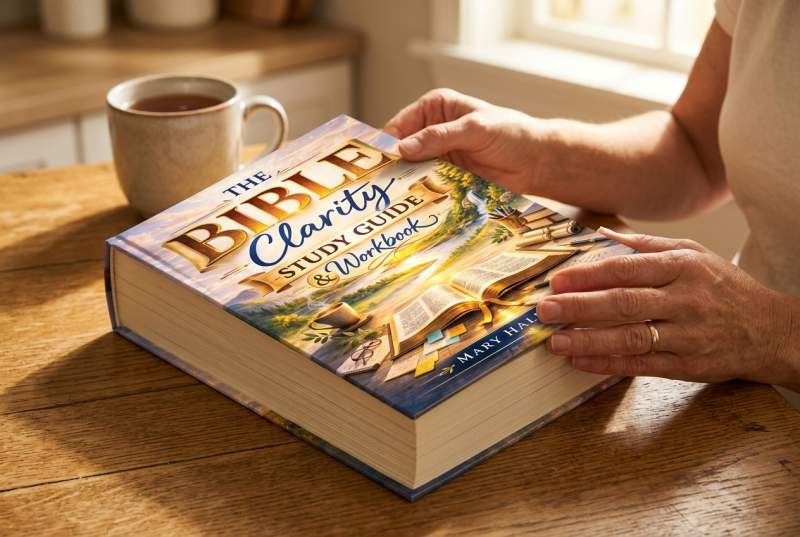
The Bible Clarity Study Guide & Workbook by Mary Halloway is a physical, all-in-one resource — a study guide and interactive workbook combined — that covers all 66 books of the Protestant Bible. What separated it from the other options our editorial team reviewed was not primarily its size or its production quality, though both are evident. It was the structural decision at the center of the design.
Every book of the Bible in this edition is introduced before the reader encounters the text — with context, themes, historical background, and an explanation of what kind of writing she is about to read. Poetry is introduced as poetry. Law is introduced as law. Prophecy is not dropped into the reader's lap without orientation. The principle — context before content — is exactly what the research points toward.
The method the guide uses is called the Bible Study Method Blueprint™, a five-step system: Read → Context → Reflect → Apply → Journal. Each step is clearly defined. Each session is complete in itself. The reader does not need to be ahead or behind a schedule, because there is no schedule. The guide is entirely self-paced — no group required, no deadlines, no external accountability structure needed to make a session worthwhile. Every purchase includes the full audiobook in MP3 format and a digital Quick Start Plan — a PDF that tells the reader exactly where to begin on the first day, eliminating the paralysis that kills most initial attempts before they reach page three.

- ✓All 66 Books — with context, maps, charts, and visual aids introduced before each one
- ✓Bible Study Method Blueprint™ — the five-step system (Read → Context → Reflect → Apply → Journal) for every session, self-paced with no group or deadlines required
- ✓Full Bonus System — full audiobook (MP3), Quick Start Plan (PDF), 40-page Journal Pack, and additional guided resources included with every purchase
What Readers Are Saying

When Bible study resources work — genuinely work, in the sense of producing comprehension rather than just completion of a session — the language readers use to describe the experience is remarkably consistent across platforms and backgrounds. They say "finally." As in: "I finally understand." "I finally feel close." "I finally feel like I can do this on my own." The word "finally" is doing significant work in those sentences. It carries the weight of previous attempts. It implies that something was tried before, that it did not work, and that this is different.
LOVE LOVE LOVE!! I feel alot closer to God with this book! I feel like I can truly do bible study on my own time. IT'S NOT OVERWHELMING, DAUNTING or DISCOURAGING — all things I have felt attempting to complete previous Bible-In-A-Year plans.— Verified Reader, Goodreads
The self-paced structure — no deadline, no group, no schedule to fall behind on — is consistently the feature that allows readers to have a first session that feels like success rather than like the beginning of something they might not finish. Thousands of readers found what they were looking for. See the edition →
"But I've Tried Something Like This Before."

The most common response from readers who have looked at the Bible Clarity Study Guide & Workbook is not skepticism about the content. It is a reasonable question about whether they will actually use it — because they have a book on their nightstand, or on a shelf, that they did not finish. This is worth addressing directly, because the concern is legitimate and the data supports it. Only 20 percent of Americans have read the entire Bible. DNF (did not finish) reviews are common across the Bible study guide category on every major platform. The people who stop are not, in the main, people who stopped caring. They are people for whom the structure of the resource eventually required more than the resource provided.
The design choice that addresses this most directly in the Bible Clarity Study Guide & Workbook is the Bible Study Method Blueprint™ — five steps that make each individual session complete in itself. When you close the book after thirty minutes, you have not fallen behind anything. You have done a complete session. The next session begins in exactly the same way. There is no accumulating deficit.
Every purchase includes a satisfaction guarantee. If the guide does not work for you, you are covered. The Quick Start Plan — included as a digital bonus with every purchase — exists specifically to solve the "where do I begin" moment that stops most first sessions before they start. Page one of the Quick Start Plan tells you exactly what to do. There is no guessing, no scrolling through 66 books wondering which one to open first.

Why 80% of Americans Who Want to Read the Bible Still Haven't — And What Finally Changed
7 min read
"We Go Every Wednesday." What Church Bible Study Groups Actually Teach — and What They Don't
8 min read